Does Lowering Salt Shorten Lifespan?
Q. About 50 years ago we were told to cut way down on salt. My brother Elmer always ate a lot of salt anyway and was always more healthy than I was. Unfortunately, he was killed in an automobile collision when he was 85.
I am now 86. When I stopped restricting salt, my health improved. If salt causes some people problems, they should avoid it. It doesn't make sense for the rest of us to deprive ourselves.
A. It has been an article of faith for decades that everyone should reduce salt intake, but the data don't show that limiting sodium consumption makes a difference for otherwise healthy people.
The latest research in the Journal of the American Medical Association (May 4, 2011) reported that lower salt intake was not associated with lower blood pressure. The people who consumed the least salt had the greatest risk of death from cardiovascular complications.
As paradoxical as this seems, it is consistent with previous research. A national nutrition survey (Journal of General Internal Medicine, Sept., 2008) found that low sodium intake was linked to higher cardiovascular mortality. A recent study of people with type 1 diabetes found that those with the lowest sodium intake were most likely to die during its 10-year duration (Diabetes Care, April, 2011).
Source
Sunday, January 23, 2011
CENSORSHIP, AMERICAN-STYLE
By Wim de Vriend
When I walk into the place, a large party of senior lunch customers is just leaving. One, a tiny lady with snow-white hair, grabs my arm and hails me as a long-lost hero. “Hello, how are you? I’ve been meaning to tell you I was all behind you, when you squirted those gals,” she gushes.
“Thank you so much,” I reply, and then I add: “But it sure was expensive.”
“But you had every right …” she starts. Sure, I had the moral right, but the political-legal establishment didn’t see it that way. What’s most astonishing, the incident with “those gals” happened over fifteen years ago, and she’s waited all this time to bring it up. So have several other people recently. There can be no doubt; as we come up to the sixteenth anniversary, I’m still known far and wide as the restaurant guy who hosed down the feminists. The latter a.k.a. locally as The Lesbians from Hell.
With some doubt that I can, I will try to make a very long story short. Halfway through the morning of Saturday July 3, 1993, I got a call at home, from the restaurant.
“Hey, they’re hee-ere,” Lynn droned in her deadpan way.
“Who is here?”
“The women’s crisis center crowd. They got signs, and they’re picketing, and they’re keeping people out of the restaurant.”
“Good grief. Ah -- are you doing any business?”
“Are you kidding? We’re standing around watching.”
“Ah -- I’ll be right over.”
Sure enough, when I got there I saw about two dozen picketers, mostly women, ambling around the place with the insouciance of hardened harridans who are sticking it to The Man. They waved picket signs. They stopped cars coming around the corner. They interfered with pedestrians headed for the restaurant by shouting things about rape, and by handing out flyers. The flyers went largely unread, but the sum total of their interference made every patron change his mind about coming in. The worst part, though, was their signs:
RAPE IS A HATE CRIME.
RAPE IS ANTI-HUMAN.
RAPE IS A GENDER BIAS CRIME.
DATE RAPE IS NOT A SPORT.
DATE RAPE IS A SERIOUS CRIME.
RAPE VIOLATES MY CIVIL RIGHTS.
BLAME RAPISTS NOT VICTIMS.
MALE ATTENTION YES, RAPE NO.
1 WOMAN IS RAPED EVERY 6 MINUTES IN U.S.
WIM DE VRIEND IS NO FRIEND.
WIM DE VRIEND, APOLOGIZE NOW.
In addition, a couple of the signs announced that this was an action by the Coos Coalition for Human Rights, the local homosexual lobby.
The restaurant is located on a downtown stretch of U.S. 101, the Pacific Coast highway. On an average day in 1993 some 15,000 vehicles passed that spot, a lot more on a summer day. This was a summer day. Hundreds, no, thousands of drivers might catch a glimpse of this scene. What would they think? Maybe what you thought when you read the slogans: that this restaurant or its owner had some sinister connection to the crime of rape. And sure enough, within days after the incident three acquaintances who had driven by told me their first thought was that I must have raped somebody. A damned infamy, when all I had done was write a letter to the paper, criticizing a radical anti-date-rape activist by the name of Dangerine, who seemed to be in charge of the picket. Dangerine had wormed herself into the position of chief of the local battered women’s home, which quickly had become known as the lesbian recruiting center. The most accurate way to describe her is to abuse Hobbes’s portrayal of primitive humanity: “nasty, brutish and short.” And what she had cooked up was not just business interference, but serious slander. I could not understand how she and her cohorts could be so blind. How was the public supposed to know that this was about a letter to the editor? Anybody with a smidgen of common sense would realize that most of those driving by had not even read it.
In a planned high-stress incident, the instigators have all the advantages of surprise. This bunch (as I discovered later) had planned their picket at meetings of the Human Rights crowd and at the Coos Bay Presbyterian Church. This church, like its national office, PC-USA, had become a haven for promoters of far-out political causes. I would also discover that nearly all of the picketers made their living off the taxpayers, which explained their disregard for my livelihood, and the support they got from the local power structure. Not counting the Human Rights boss, they included Dangerine, her lesbian “counselors” from the Women’s Crisis Center, a few county social workers, a public employees’ union activist, a probation officer, the wife of a retired public school administrator locally infamous for drunkenness on the job, and the wife of a judge. The conspirators had talked to the Coos Bay police about their plan, and the police had told them to go ahead but had not seen fit to tell me, or I might have done something more sensible than I did.
For I didn’t know most of these things I just told you; to me, these people were simple troublemakers interfering with my livelihood and ruining my reputation. When we called the police for help, we were told they were too busy. So I set out to get rid of the pests myself. In downtown Portland, along Burnside Avenue, merchants have had a lot of trouble with bums blocking access to their businesses and scaring off customers, and quite a few have installed sprinkler systems on the outside walls of their buildings. At irregular intervals they turn them on to dampen the spirit of the scruffy sidewalk assemblies. Having grown up in a water-rich country where disputes were often resolved by dunking obstreperous people in the nearest pond or canal (It happened to me), I thought water was a most sensible cure. So I quickly joined a couple of garden hoses together, climbed on my roof, and started hosing the picketers down. For a few minutes this made a few run away, especially the feminized men; but then they re-grouped en masse and started marching womanfully through the spray. According to a potential eyewitness who evaded showing up at trial, Dangerine urged her collaborators to get as wet as they could. In our highly politicized society, agents provocateurs often win the victim’s prize.
Once I realized that hosing the harridans was as effective as pouring gasoline on a fire, I sat down on my roof, at a loss what to do next. Then I saw that my gutter had collected so much dirt, grass was growing in it. I pulled out some clumps, intending to throw them into the back yard. Just then I caught sight of Dangerine down below, and she caught sight of me.
“You f-ckin’ …. !!!!” she screamed, shaking her calloused fist.
It was in my hand; I had to let go. But my aim has never been great.
“SPLAT!” said the clump of mud, glancing off her shoulder and missing a golden chance to improve her face.
Hmm. Now I felt I had done more than enough; a tactical retreat seemed advisable. Dragging the hoses back across the roof, I climbed down to get a situation report, and found the restaurant staff all shook up. While I was up there a frantic girl had burst into the place, screaming and carrying on about how terrible we all were until they pushed her out the door. As we found out later, that was Dangerine’s daughter.
But we didn’t know this, nor did we know much else; on our side, confusion reigned. I believe it was at that point that the picketers called the police, demanding that they arrest me. This time, two cops promptly arrived. After spending considerable time outside, interviewing the picketers, Coos Bay’s finest came in not to get my side of things but to charge me with multiple counts of “harassment” on account of the water-spraying, plus assault because Dangerine claimed her shoulder hurt due to the mud clod. She also said she was “pretty much covered with dirt”. The picture nearby shows the remains of the mud, near her feet. Draw your own conclusions. Regardless, the police said that an assault charge required me to be arrested and booked, so to the considerable glee of the picketers I was handcuffed and hauled off to the county courthouse to be booked.
Once there, the county jail deputies were as nice as they could be, and they were sorry that their holding cell contained nothing for me to read until a relative came to collect me. But before they started the fingerprinting and photographing, one deputy asked the city policemen what I had done. They told him.
“Whoa–” he stammered, “shouldn’t we give him a medal for that, instead?” Obviously the county jail was on the long list of places where Dangerine, that indomitable advocate of female innocence, had made a total pest of herself.
For a week or so it was not clear what would shake out of all this commotion. Business was slow for the time of year, and getting slower; clearly we’d been hurt where they meant to hurt us. But a lot of people expressed moral support, some making a point of patronizing my place, including several whom the picket first led to believe I must have raped somebody. Lord knows how many more never learned the truth. During those weeks, too, I gained a new respect for ordinary people because they, not the politicians, not the lawyers, and least of all the feminists, understood what this was all about. It was not about rape, and it was not about the “rights to free speech” of the picketers, although they loudly and constantly trumpeted those rights. One lady from North Dakota wrote: “Dear sir. I read in the paper about your spraying those women with a water hose. I feel you had a right to your opinion … I also think you had a right to protect your business from those who were obstructing your place.” Exactly. We might not have government-sanctioned censorship in the United States, but the picketers had appointed themselves censors. And, they got away with it. My consolation prize was an instant of national fame, as the restaurant owner who hosed down a bunch of picketing feminists. When I shopped out of town, merchants would recognize me and give me things. Some people sent money. That was welcome, for this was going to cost me.
Meanwhile my opponents spread lies, engaged in name-calling, and conducted a whisper-campaign to convince the public that I approved of rape. Deriding everything in my letter as untrue, they called me a fascist, which happens to be a tactic pioneered by Stalin. And as she had done throughout her do-gooder career, Dangerine took the opportunity to promote herself as the victim. She accused me of being a misogynist and an anti-Semite, and proposed that her staff at the picket be nominated for sainthood. That would have made the most peculiar set of saints in the history of Catholicism,
I also happened to run into Dangerine’s ex-husband, who apologized profusely: “I’m sorry! I’m sorry! I’m sorry for what she did you!”
“Well, it wasn’t exactly your fault.”
“I know! But I’m the one who brought her here! She’s a monster!”
And then he told me a story from his turbulent marriage. Not being an intellectual but more of a hands-on character, he offered neither an explanation nor an analysis, but it was so weird, he could not have made it up. Dangerine had been the spouse-abuser in their marriage. On one occasion she was beating him up in their bedroom. While pounding him on the side of the head – and she could put some weight into it – their daughter, then only 9 years old, was hiding under a blanket. And while pounding him Dangerine was screaming: “Ouch! You’re hurting me!” Afterward he needed medical attention for a shattered eardrum, and I could tell that he had suffered some hearing loss.
Shortly after this, one of his employees told me he was present when Dangerine gave her man another thrashing while the pair was rolling down the hillside outside their home. After that the husband had to go on tranquilizers, and he was not a weenie. Shortly after the picket I also learned that the daughter who had thrown the hissy-fit inside the restaurant had publicly beat up her boyfriend who lived next door, at the same time trashing his car and screaming that he was a stupid Mexican. Although it deserves to be made, my point is not that the apple doesn’t fall far from the tree. Instead, it is that equality of the sexes or caring for abused people or any other feel-good cause is not what this kind of feminism is about. Those are pretexts. This feminism is about creating a new tyranny, but in order to do so it needs to impose its own belief system. And agnostics must be trashed.
I wrote a letter to the District attorney, demanding that he prosecute the picketers for intimidation, coercion, and violating my right to free speech. No response. Instead, increasingly ominous pieces of information dribbled in. One was the picket’s domination by government employees, including those with a connection to the local “justice” establishment, particularly the judge’s wife. When I contacted local attorneys about taking my case, nobody was interested. Neither was the local paper, which for some time already had been Dangerine’s mouthpiece, paid and unpaid. The paid items included advertisements that demonized men and heterosexuality. One ad hinted ominously:
“Dating someone is better than dating no one. OR IS IT? Abusive behavior occurs in 50% of all dating relationships.” Another ad was no less startling: “WARNING! Dating may be hazardous to your health!” And a picture of a man and woman having a pleasant conversation carried the startling message: “Did This Woman Deserve To Be Raped?”
Besides getting paid for spreading this kind of terror, the newspaper had been filling many free column-inches with Dangerine’s harangues against the American male as a spouse-beating brute, a serial date-rapist, and a pathological dirty old man who would subject his own little children to sexual abuse so horrible that they had forgotten all about it. Those buried horrors could then be “recovered” by therapists such as Dangerine.
An even-handed check of social-science research reveals that blaming men for all those problems is like Mark Twain’s reaction to his premature obituary: greatly exaggerated. People do bad things, yes, but both sexes do. With regard to domestic violence, studies have shown it is just as likely to be initiated by females as by males, with the females more likely to use weapons. But you’d never know it, as demonstrated by the customary refusal of women’s shelters to receive abused men. Studies also show that many women – up to half – lie about having been raped; we’ve seen some infamous cases in recent years. And while Dangerine’s third obsession, “recovered” memories of incest, has no scientific basis, it’s been shown that such memories can be implanted in the minds of neurotic women by overzealous social workers and prosecutors. But practical politics, as the famous historian Henry Brooks Adams observed, consists of ignoring facts. What is worse, politics seems to attract a lot of power-hungry people. Bullies who practice deceit and spread paranoia.
So now, you may wonder, what of this letter of mine that had provoked the Lesbians from Hell? Shortly before the picket, a majority-female jury had returned an acquittal in a local man’s “date-rape” trial. This had induced the Coos Bay paper to run another puff-piece on Dangerine, in which both she and the district attorney carried on like sore losers. Dangerine proclaimed that every man accused of rape must be presumed guilty and found guilty, and the woman, being incapable of lying, shouldn’t even have to appear in court. This had induced me to write my letter. In view of the results, I may fit a famous description by George Eliot: “[he] suspected himself of loving too well the losing causes of the world.”
“It is in the nature of our court system that not everyone accused of a crime is convicted, and that people accused of crimes may confront their accusers in court. It looks like [Dangerine] wants to do away with such inconveniences. … While foreign to our tradition, [Dangerine’s] legal concepts can be effective. During the French revolution, they made lots of innocent heads roll.
It is true that many date-rape cases are dismissed or end in acquittal. If this proves a conspiracy against women, I would like to know why the women on our juries participate in it.
We should all be grateful that juries substitute a considered opinion for the snap judgment of one extremist. … Certain noisy feminists excepted, women still enjoy flirtation and male attention. Our society has done away with the stigma attached to unmarried intercourse. So when relations occur after a couple of dates, or even one, who decides that it was rape? The man may have been better at wining and dining than at doing “it”. The woman may be disappointed. A few days later, she decides she has really been raped. How can a jury determine what happened … ?
For rape to occur, the woman must object before the fact, not after. And the most effective prevention consists of taking the bull by the horns. Remember: this is date-rape, no guns or knives. When the unwanted act is about to occur, the rapist will expose the necessary equipment. All that an unwilling woman has to do then is grab half of it and not let go. With some force, she then applies the movements used in wringing all the water from a wet towel. Any woman who doesn’t know the sensitivity of these male parts is too dumb to go out on dates. And every would-be rapist subjected to the procedure will change his mind faster than you can say ‘feminazi’”.
Did my letter contain logic? Yes it did. Did it contain truth? Nothing but. But what about my advice to women who didn’t want to be date-raped? I’ve heard some people say this could not possibly work. But they are uninformed. As a tactic it has proved itself, and it’s recommended by self-defense experts, too. It has even been promoted on Oprah. I’ll be glad to provide sources. But my tormentors on July 3 would have none of it.
In accusing me of anti-Semitism, Dangerine’s logic ran like this: I had called her a “feminazi”; she was of Jewish descent; so that made me an anti-Semite. Of these three statements, only her Jewish origin was true, sort of. I doubt that she practiced the Jewish faith, and in reality I was the Jew in this scenario. Sixty years on, the 1933 Nazi-German picket of Jewish merchants had been re-enacted, this time by American feminist storm troopers.
At first I had trouble believing that I would be prosecuted, when I had been the one victimized. But that’s what happened. The assault charge was not pursued, because Dangerine had no real injury. But since I had been arrested they had to charge me with something, so I faced multiple counts of “harassment” for the water-spraying and for throwing the mud-clod. The district attorney’s office offered to prosecute these charges as “violations” instead of misdemeanors, which would save me from a possible jail sentence, but mere violations did not qualify for a jury trial, just a trial before a judge. In hindsight, I believe the jail sentence threat was theoretical. But I took the bait and opted for the violations, and when I had second thoughts the court was adamant that I could not change that decision. A jury trial would have been far, far better for me.
What I should explain, though, is why I tied myself in knots over a court proceeding that could at worst cost me as much as a few technical traffic violations. This may sound strange, but I was fighting disillusionment. As an immigrant I had developed great admiration for the way the American government had been structured by the founders. I was especially awed by the federal First Amendment, aware that while most governments guarantee freedom of speech on paper, nobody has it except the Americans, since their government has accepted "… the principle of free thought, not free thought for those who agree with us but freedom for the thought that we hate." (Justice Holmes in U.S. vs. Schwimmer, 1929.) Every place else in this world, a mere expression of opinion may be prosecuted if some authority feels it may hurt somebody’s feelings, and unlike in America, truth is no defense. The élites in those countries advance good reasons for their speech bans, but they make sense only if you ignore the fact that opinions that offend nobody don’t need constitutional protection in the first place.
In truth, my admiration for the First Amendment made me overconfident, not to say naïve. No matter what the Constitution or the Supreme Court say on the subject, people will find ways to censor speech they don’t like. I was a latter-day Don Quixote, on a quest for a moral victory. But moral victories are more common in movies.
An eager-beaver junior prosecutor who must have made straight A’s in Arrogance-101 took charge of my multiple “violations”. That year’s session of the Oregon Legislature approved a bill forbidding prosecutors in the state from handling violations. But that came too late for my case, which demonstrated the pernicious effects of the American sports mania on legal morals – if such there be. In the legal business as in sports, it’s all about winning.
To get to his goal post, the junior d. a. used several tactics. One, he took the position that the picketers had not interfered with my business, which was laughable. Two, even if they had interfered (which he never admitted), or if they had defamed me, that had nothing to do with the charges against me, and should be pursued as a civil matter later on. This can be described as the “Salami-tactic”, see below. And third, he was nauseatingly obsequious to the picketers’ whining about being hosed, suggesting (among other things) that my garden hose had the power of a jet engine. In the process he got them to produce the kind of ranting typically produced by hormonal imbalances. The understandable part of these rants was that being sprayed with water was like being molested and raped.
The “salami-tactic” was identified many years ago by German students of politics. It consists of dividing an issue into segments small enough so no reasonable person can object to the disposition of each individual part. The party who divides the issue (or slices the salami) fully intends to eat all of it, but he doesn't let on. In the end, he gets everything he wants while everyone else wonders how such a thing could have happened.
The legal establishment is very fond of the salami-tactic, due to its belief that justice will result from splitting up every case into its smallest constituent pieces. After doing so, they concentrate on one little part while ignoring the rest. Once enough tiny sub-parts ‑‑ or salami slices, if you will – have been dealt with in this manner, the accumulation of multiple small decisions will acquire such momentous logic that the big one almost makes itself. And that, of course, was the real goal of the salami-eater.
In my case, the d. a. insisted that the judge could not consider the context of the incident and what the picketers were doing to me; he could only rule on what I had done in the heat of the moment – a moment the picketers had staged. In a regular trial we could have got the jury to consider the whole salami, not just the hosing of the harridans but the harm they inflicted on my livelihood and my reputation. A jury could have done so despite the instructions of a judge. In Oregon as in many states, juries have the power to judge whether applying the law in the case at hand will be just or not. If not, they can acquit. It’s called jury nullification. And there is nothing the judge can do about it, even though he pretends otherwise.
Also working to my advantage in a jury trial would have been the labor-union background of many jury members. My accusers were unanimous in claiming that they never meant to cause my business any harm. But most people in a blue-collar town know that the primary purpose of a business picket is to do exactly that: cause harm.
But I did not have a jury; my goose was cooked, for the judge went right along with the toadying d. a. and his pet victims. That is, when the pontifications of the “victims” were not putting him to sleep.
State: “Did you find when you were sprayed with water, is this offensive to you?”
Dangerine: “As an incest survivor, it was horrifying.” [Laughter]
State: “Did you ever state to Mr. de Vriend – “
Dangerine: “And I don’t find it funny that I am an incest survivor.” (p. 60, transcript)
State: “What was the reaction of the crowd once he started spraying them with water as far as from an emotional standpoint?”
Dangerine: “I hope this doesn’t again get laughs. But there were women there who are victims of sexual assault and they chose to come there and for somebody to again be assaulted, it is very upsetting. I realize I say things in this court room as why we were there, but it is offensive and it’s scary, it’s horrifying for somebody to then again be assaulted. This was an assault. For those of us who have been assaulted in our lives, reading this letter or having somebody spray us. Or having somebody hit us, is not a very pleasant experience, and I realize that there are many people in this court room who do not understand what I am saying, and that’s why we continue to do what we do.”
State: “And did all of these events occur in Coos County?”
Dangerine: “Yes.”
State: “Nothing further.”
. . .
Defense: “You said that it was horrifying to be hit with a dirt clod.”
Dangerine: “Yes, it was.”
Defense: “How do you equate a dirt clod with sexual assault?”
Dangerine: “I will equate it with what was written in the letter, be it assault and the words that were used against me and that somebody deliberately looked at me with the intent of not throwing it in any direction, excuse me, but in the intent of hurting me personally. And it brings back memories that are very uncomfortable for me.” (p. 62)
Loverless: “… And he looked me right in the eye, and he said, “You’re one of them.” And he sprayed me right in the face, and all down my body, up and down nice and slow, you know, like nice and slow. And by golly, I felt raped! (p. 79)
State: Did he spray you?
Cripling: Yes.
State: How wet did you get?
Cripling: Soaked.
State: Did you find this offensive?
Cripling: Yeah, it’s really scary because – you know – we knew how he felt about rape, and so I consider rape a violent crime, So, I considered him a violent man and I didn’t know what else he might do. (pp 98/99)
The judge gave no weight to the outrageous defamation generated by the picketers:
Defense: What did you see?
Booth: Well, I saw 15-20 people holding signs that I thought were very offensive towards Wim, libelous. … I thought they were almost blocking traffic – close to it. And the signs that I saw – all I could think was, “Jesus, what has Wim done?” You know – “Has he raped somebody?” Jesus – and his wife – you know – what could have happened? (p. 102)
West: … I had to slow a little bit, and the light was just turning and we saw this bunch of picketers walking in a circle around the sidewalk with their signs, and the only sign that stuck out in my mind, of course, as you are trying to drive and look over there, was one that somebody was carrying that I think had the words “Date Rape Is Not A Sport” or “Date Rape Is No Sport”, I don’t remember the exact words. They continued milling around and we went on through the light and my wife turned to me and asked, “Do you suppose that Wim got involved with one of his waitresses?” (p. 127)
The trial took the better part of a day – an unusually warm day for an area without air conditioning. Before long the unventilated, crowded court room became oppressive, and the break brought no relief when the audience got treated to a hallway show of giggling, smooching lesbians. At the end of the day the judge found me guilty on all charges, and fined me about $1,300.
Because of the presence of a Coos County judge’s wife among the picketers, the trial had originally been assigned to a judge from a different county, who seemed to be strict but fair. But to our surprise, at the last minute he’d been replaced by a retired Coos County judge who apparently needed a little moonlighting. As soon as he had pronounced his sentence and we walked out in a daze, I was approached by two different acquaintances who asked if I had noticed he had slept through part of the proceedings. I was astonished. I had hardly looked at the man, being so intent on what everyone else was saying.
But, outraged by the verdict, I armed myself with affidavits from both observers to lodge a complaint for misconduct with the state bar disciplinary association. That self-protective fraternity conducted some sort of procedure, but except for informing me that they had done so they never told me their decision. Them’s the rules of the old boys’ club.
Dark, restless nights followed dark days, although they were again brightened by some great people. The morning after the verdict my old friend Lorance Eickworth walked into the restaurant and handed me a check for $400. Lorance had been a life-long gadfly on Coos Bay’s body politic, and he knew a price has to be paid.
Meanwhile my opponents, flush with victory, conducted a campaign of harassment. Off and on we got weird phone calls at the restaurant from what sounded like a lesbian orgy, and when I finally received an obscene letter with the Women’s Crisis Center’s address, I took it to the police. The policeman reported that everyone at the Crisis Center denied having sent it, but they promised it wouldn’t happen again.
I suppose it was an act of defiance when I acquired a World War II “Save Freedom of Speech” poster to hang in the restaurant. The truth is, though, that Norman Rockwell’s scene has a maudlin element of unreality. I’ve never attended a public meeting where everybody lavished adoring looks on a common man speaking up; where are the bored, the skeptical, the scoffers and the dozers? Not to mention the teenage girls blowing bubble gum. More to the point, the poster calls on people to buy war bonds to protect freedom of speech. But does the primary danger to our civil liberties come from raving foreign dictators, or from ranting domestic do-gooders?
After several months I worked up enough steam to initiate the second phase of my tale, a civil suit for defamation and business damages, but that one was torpedoed by a judge’s ruling that the picket signs could not possibly have constituted defamation. How can you explain such a thing except by corruption or incompetence?
One night I woke up around 3 AM again, unable to sleep, went to my living room and took out my bible. It fell open to Matthew 5:11:
“Blessed are you when people insult you, persecute you and falsely say all kinds of evil against you because of me. Rejoice and be glad, because great is your reward in heaven, for in the same way they persecuted the prophets who were before you.” (NIV)
That one hit me hard; but I still possessed enough skepticism – or modesty, hopefully – to object silently that I had not exactly done it for Him. I had been feeding my pride.
“But I know how you feel.”
Monday, January 10, 2011
The Arizona Tragedy and the Politics of Blood Libel
Those who purport to care about the tenor of political discourse don't help civil debate when they seize on any pretext to call their political opponents accomplices to murder
By GLENN HARLAN REYNOLDS
Shortly after November's electoral defeat for the Democrats, pollster Mark Penn appeared on Chris Matthews's TV show and remarked that what President Obama needed to reconnect with the American people was another Oklahoma City bombing. To judge from the reaction to Saturday's tragic shootings in Arizona, many on the left (and in the press) agree, and for a while hoped that Jared Lee Loughner's killing spree might fill the bill.
With only the barest outline of events available, pundits and reporters seemed to agree that the massacre had to be the fault of the tea party movement in general, and of Sarah Palin in particular. Why? Because they had created, in New York Times columnist Paul Krugman's words, a "climate of hate."
Pima County, AZ Sheriff Clarence Dupnik held a press conference during which he blamed vitriolic political rhetoric for provoking the mentally unstable, and lamented Arizona's becoming the "mecca of prejudice and bigotry." Video courtesy of AFP.
The critics were a bit short on particulars as to what that meant. Mrs. Palin has used some martial metaphors—"lock and load"—and talked about "targeting" opponents. But as media writer Howard Kurtz noted in The Daily Beast, such metaphors are common in politics. Palin critic Markos Moulitsas, on his Daily Kos blog, had even included Rep. Gabrielle Giffords's district on a list of congressional districts "bullseyed" for primary challenges. When Democrats use language like this—or even harsher language like Mr. Obama's famous remark, in Philadelphia during the 2008 campaign, "If they bring a knife to the fight, we bring a gun"—it's just evidence of high spirits, apparently. But if Republicans do it, it somehow creates a climate of hate.
There's a climate of hate out there, all right, but it doesn't derive from the innocuous use of political clichés. And former Gov. Palin and the tea party movement are more the targets than the source.
Jared Lee Loughner, the man suspected of a shooting spree that killed a Federal Judge and critically wounded Congresswoman Gabrielle Giffords, had left a trail of online videos in which he railed against the government. WSJ's Neil Hickey reports.
American journalists know how to be exquisitely sensitive when they want to be. As the Washington Examiner's Byron York pointed out on Sunday, after Major Nidal Hasan shot up Fort Hood while shouting "Allahu Akhbar!" the press was full of cautions about not drawing premature conclusions about a connection to Islamist terrorism. "Where," asked Mr. York, "was that caution after the shootings in Arizona?"
Set aside as inconvenient, apparently. There was no waiting for the facts on Saturday. Likewise, last May New York Mayor Michael Bloomberg and CBS anchor Katie Couric speculated, without any evidence, that the Times Square bomber might be a tea partier upset with the ObamaCare bill.
So as the usual talking heads begin their "have you no decency?" routine aimed at talk radio and Republican politicians, perhaps we should turn the question around. Where is the decency in blood libel?
To paraphrase Justice Cardozo ("proof of negligence in the air, so to speak, will not do"), there is no such thing as responsibility in the air. Those who try to connect Sarah Palin and other political figures with whom they disagree to the shootings in Arizona use attacks on "rhetoric" and a "climate of hate" to obscure their own dishonesty in trying to imply responsibility where none exists. But the dishonesty remains.
To be clear, if you're using this event to criticize the "rhetoric" of Mrs. Palin or others with whom you disagree, then you're either: (a) asserting a connection between the "rhetoric" and the shooting, which based on evidence to date would be what we call a vicious lie; or (b) you're not, in which case you're just seizing on a tragedy to try to score unrelated political points, which is contemptible. Which is it?
I understand the desperation that Democrats must feel after taking a historic beating in the midterm elections and seeing the popularity of ObamaCare plummet while voters flee the party in droves. But those who purport to care about the health of our political community demonstrate precious little actual concern for America's political well-being when they seize on any pretext, however flimsy, to call their political opponents accomplices to murder.
Where is the decency in that?
Source
Those who purport to care about the tenor of political discourse don't help civil debate when they seize on any pretext to call their political opponents accomplices to murder
By GLENN HARLAN REYNOLDS
Shortly after November's electoral defeat for the Democrats, pollster Mark Penn appeared on Chris Matthews's TV show and remarked that what President Obama needed to reconnect with the American people was another Oklahoma City bombing. To judge from the reaction to Saturday's tragic shootings in Arizona, many on the left (and in the press) agree, and for a while hoped that Jared Lee Loughner's killing spree might fill the bill.
With only the barest outline of events available, pundits and reporters seemed to agree that the massacre had to be the fault of the tea party movement in general, and of Sarah Palin in particular. Why? Because they had created, in New York Times columnist Paul Krugman's words, a "climate of hate."
Pima County, AZ Sheriff Clarence Dupnik held a press conference during which he blamed vitriolic political rhetoric for provoking the mentally unstable, and lamented Arizona's becoming the "mecca of prejudice and bigotry." Video courtesy of AFP.
The critics were a bit short on particulars as to what that meant. Mrs. Palin has used some martial metaphors—"lock and load"—and talked about "targeting" opponents. But as media writer Howard Kurtz noted in The Daily Beast, such metaphors are common in politics. Palin critic Markos Moulitsas, on his Daily Kos blog, had even included Rep. Gabrielle Giffords's district on a list of congressional districts "bullseyed" for primary challenges. When Democrats use language like this—or even harsher language like Mr. Obama's famous remark, in Philadelphia during the 2008 campaign, "If they bring a knife to the fight, we bring a gun"—it's just evidence of high spirits, apparently. But if Republicans do it, it somehow creates a climate of hate.
There's a climate of hate out there, all right, but it doesn't derive from the innocuous use of political clichés. And former Gov. Palin and the tea party movement are more the targets than the source.
Jared Lee Loughner, the man suspected of a shooting spree that killed a Federal Judge and critically wounded Congresswoman Gabrielle Giffords, had left a trail of online videos in which he railed against the government. WSJ's Neil Hickey reports.
American journalists know how to be exquisitely sensitive when they want to be. As the Washington Examiner's Byron York pointed out on Sunday, after Major Nidal Hasan shot up Fort Hood while shouting "Allahu Akhbar!" the press was full of cautions about not drawing premature conclusions about a connection to Islamist terrorism. "Where," asked Mr. York, "was that caution after the shootings in Arizona?"
Set aside as inconvenient, apparently. There was no waiting for the facts on Saturday. Likewise, last May New York Mayor Michael Bloomberg and CBS anchor Katie Couric speculated, without any evidence, that the Times Square bomber might be a tea partier upset with the ObamaCare bill.
So as the usual talking heads begin their "have you no decency?" routine aimed at talk radio and Republican politicians, perhaps we should turn the question around. Where is the decency in blood libel?
To paraphrase Justice Cardozo ("proof of negligence in the air, so to speak, will not do"), there is no such thing as responsibility in the air. Those who try to connect Sarah Palin and other political figures with whom they disagree to the shootings in Arizona use attacks on "rhetoric" and a "climate of hate" to obscure their own dishonesty in trying to imply responsibility where none exists. But the dishonesty remains.
To be clear, if you're using this event to criticize the "rhetoric" of Mrs. Palin or others with whom you disagree, then you're either: (a) asserting a connection between the "rhetoric" and the shooting, which based on evidence to date would be what we call a vicious lie; or (b) you're not, in which case you're just seizing on a tragedy to try to score unrelated political points, which is contemptible. Which is it?
I understand the desperation that Democrats must feel after taking a historic beating in the midterm elections and seeing the popularity of ObamaCare plummet while voters flee the party in droves. But those who purport to care about the health of our political community demonstrate precious little actual concern for America's political well-being when they seize on any pretext, however flimsy, to call their political opponents accomplices to murder.
Where is the decency in that?
Source
Tuesday, November 02, 2010
Day of the Democratic Dead: November 2, 2010
This election is a referendum not on Obama personally, but on Obama as liberal progressive
By Henry Olsen, vice president of the American Enterprise Institute
For Delaware Democrat Chris Coons, it’s fitting that Election Day comes two days after Halloween, running as he is against that sometime dabbler in witchcraft, Christine O’Donnell. For hundreds of his partisan brothers and sisters, however, another holiday reference is more appropriate: Mexico’s Day of the Dead. Today, our neighbors to the south will begin celebrating the memories of their deceased family and friends. Tomorrow, our neighbors to the left will mourn the demise of hundreds of candidates whose careers will be consigned to the political graveyard, few of which will rise to take bodily form again.
How did it come to this? Just two years ago, all things seemed possible for Democrats. In possession of congressional majorities larger than any since 1980, led by a seemingly historic figure who had just won a larger share of the popular vote than any non-incumbent Democrat since FDR in 1932, Democrats forecast an American political sky that would remain endlessly blue. Today, Democrats are headed for a reversal of fortune of proportions not seen since the landslide elections of 1946 and 1948.
How strong will this reversal be? I predict that Republicans will gain between 55 and 72 seats in the House; my best estimate is 64. That will give the GOP 243 seats, its highest total since the election of 1946 and the second highest since the Great Depression. No living Democrat has served in a House of Representatives with as few Democrats as will inhabit that body come January.
Furthermore, I predict that the GOP will gain nine Senate seats, giving it 50 members. That means the Republicans will nearly capture the slate in the seats up for grabs, losing only West Virginia in a nailbiter among the close seats in the polls. I would not at all be surprised if one Democrat — perhaps Jim Webb of Virginia — subsequently switches parties or changes which party he caucuses with to give the GOP operational control of the Senate. (Those interested in my specific seat-by-seat predictions should keep their eye on the Corner.)
Many will blame the economy for this situation, arguing that no party in the midst of the worst economic crisis in at least 30, and perhaps 80, years could have satisfied the electorate. There is truth to this, as the party in power always suffers at the polls during a significant recession.
But this explanation goes only so far. The anger, disappointment, and disgust that the voters will shower on the Obama administration and the Democratic congressional leadership is unusually deep. The electorate is reacting at a much more visceral level.
In my private election-prediction memo two years ago, I wrote the following words: “Democrats are split between progressives, who seek a radical and swift move to the economic left, and centrists, who want to re-regulate and ‘spread the wealth around’ but nowhere near the degree of the progressives.#…#Who will win these intra-party fights? We don’t know, and which faction wins and to what extent will largely determine both the health of our nation and the possibility of a quick Republican resurgence.”
We now know that the progressives, despite their dissatisfaction with many elements of President Obama’s agenda, largely won those fights. The result is that large segments of the American electorate feel that the administration and Democrats in Congress don’t understand and don’t care to understand their aspirations and fears. This sentiment is most keenly and strongly felt among conservative Republicans, but it is shared — for different reasons — by many nonconservatives. This sentiment is particularly strong among the white working class and among Catholics.
The development of this sentiment was not inevitable. President Obama took power with the strong support of most Americans, who hoped and believed he could make America whole again. Instead, in his deeds and in his words, in what he has done and in what he has failed to do, he has alienated the vast American middle.
Why did he do and say what he did? Why did those words and deeds alienate the American middle and working classes? Is there something inherent in progressive politics that is out of sync with American attitudes and aspirations?
To understand the answers to these questions, we must understand that this election is only the latest battle in what I have called the Fifty Years’ War between progressives and conservatives for possession of America’s political soul. One can understand the president’s words and deeds only if we understand both what the war is about and how Democrats themselves differ about how to fight the war. So it is to that issue that I now turn.
THE FIFTY YEARS’ WAR
At the political level, the Fifty Years’ War is about what defines American freedom. Is the promise of America that everyone enjoys the right to life, liberty, and the pursuit of happiness best kept when government is minimally involved, either through regulation or taxation, in individual decision making? Or is it best kept when government removes material and immaterial obstacles to some individuals’ ability to make the decisions they would prefer to make, even if removing those obstacles places obstacles in the paths of other Americans?
Conservatives have a tendency to agree with the first proposition, while progressives have a tendency to agree with the second. But for progressives there is a second, pragmatic question to answer: Should necessity — in the form of voter opinion and economic factors — significantly constrain the pursuit of justice? Progressives differ among themselves on this question, and it is this difference that forms the heart of the battle between the “moderates” and “liberals” within the Democratic party.
Liberal progressives say necessity should have a minimal role in constraining the pursuit of progressive justice. If voters don’t agree with a progressive view of rights, recourse to the courts to overrule them is proper. Voters’ desire, and especially well-off voters’ desire, to keep taxes low and the economy growing ought not to be a significant factor in bringing medical care to poor people or saving the planet from greenhouse gasses.
Moderate progressives take the contrary view. Justice can be secure only if it is secure in the hearts and minds of the people, they believe. They place more faith in, and pay more deference to, voters’ desires, not because they don’t believe in progressive aspirations, but because they believe those goals can best be achieved through incremental measures that receive broad popular support.
We can see this clash most clearly in the reactions of both camps to the Clinton presidency and to Hillary Clinton’s once and future candidacy. To liberal progressives, the Clinton presidency is anathema. It was too timid when it had power in 1993–94, and too conciliatory when it shared power with a Republican Congress thereafter. This belief fueled the challenges to Al Gore in 2000 by Bill Bradley in the primaries and Ralph Nader in the general election. It fueled Howard Dean’s 2004 bid, and was the impetus behind much of the support for Barack Obama’s challenge to frontrunner Hillary Clinton in 2008.
To moderate progressives, the Clinton presidency is the model of progressive action in the modern world. Clinton’s go-slow approach, coupled with his continued pursuit of progressive spending and social policies where possible, meant that progressive policies became imbedded in the middle-class mindset, making them impervious to conservative counterattack.
These differences did not arise with Bill Clinton, though. The seeds for this Democratic division extend much further back in our political history, to the start of the current political era in the 1960s. Each side in this progressive civil war draws different lessons from what happened in the 1960s, 1970s, and 1980s, lessons that carried through into their different paths in the 1990s and remain to the present day.
THE LEGACY OF THE SIXTIES
Today’s liberal progressives are directly descended from the “New Left” of the 1960s. By this I do not mean student radicals, SDS members, Yippies, and others of the radical fringe of this movement. Instead, I define the “New Left” as those Americans — largely bearers of college and postgraduate degrees — who sought not merely to ameliorate some of the hardest edges of American life, as FDR did with the New Deal, but rather to transform American life now. They sought to eliminate, not ameliorate, poverty now. They saw Americans’ pursuit of ever-increasing wealth as an impediment to these goals; why should already well-off families have more when some people had little? And they saw American defense spending as a crucial obstacle to these goals; if no one was attacking us directly, why shouldn’t we spend on butter rather than bombs?
The New Left was characterized as much by its impatience as by its lofty ambitions. Its advocates saw the non-attainment of their goals as a moral crime. As such, those who stood in the way of those goals were not merely adversaries, they were enemies: selfish, unlettered, in need of enlightenment. This sentiment is the source of the arrogant condescension that many Americans and most conservatives have felt all too frequently is a defining feature of today’s Left.
The New Left and today’s liberal progressives, then, interpret America’s political history very differently from the way conservatives and moderate progressives do. They see the victory of Richard Nixon in 1968 and 1972 as catastrophic. As much as conservatives see Nixon as a liberal because of his imposition of wage and price controls and his failure to even seriously try to dismantle much of the Great Society, liberal progressives see his victory as a watershed, because he stood as an impediment to the rapid attainment of their goals. If Nixon’s victory was catastrophic, Reagan’s victory was epochal. Reagan and his heirs promised not just to stand in the way of achieving liberal progressives’ deepest dreams; they stood pledged to question the very assumptions of the progressive project and roll them back if they could.
To reverse these trends, liberal progressives knew they had to control the Democratic party, and to do that they had to nominate and elect one of their own to the presidency. Thus was born the now endemic battles between the progressives and the old guard (unions and party bosses in the ’80s, the DLC in the ’90s and ’00s) in Democratic nomination contests. The liberal progressive candidate would win educated voters — the “wine set,” as Ron Brownstein has labeled them — while the moderate progressive candidate would win the middle and working classes — Brownstein’s “beer set.” Since beer drinkers have always outnumbered wine drinkers in Democratic primaries, the candidates who excited the most progressive elements always lost — until Barack Obama broke the mold in 2008 by attracting African-American “beer drinkers” into the progressive camp.
Liberal progressives view these consistent defeats as examples of justice denied. Their consistent rejection by the voters is seen not as a rejection of their impatience or lofty ambitions, but as something more sinister. The voters were bamboozled by the Teflon Great Communicator, by Willie Horton ads, by triangulating good old boys, by corporate interests, and by blockheaded Texans backed by unscrupulous Mayberry Machiavellians. Something is the matter with Kansans if they don’t back progressives; it must be devious politicians who divert middle- and working-class voters with the bread and circuses of phony social issues and unnecessary foreign wars. The solution: Organize new constituencies, particularly among the young and among ethnic minorities, through the internet (Daily Kos, MoveOn.org), local groups (ACORN), and D.C.-based interest groups (EMILY’s List, Center for American Progress), and continue to press for progressive justice in bold colors, not pale pastels.
DEMOCRATIC THERMIDOR
As the continued failure of progressive candidates in Democratic presidential primaries shows, a majority of Democrats are not of this lineage. These moderate progressives place a very different interpretation on what went wrong in the ’60s and ’70s, and have adopted a very different view of how to engage in and shape American politics.
Moderate progressives view the rejections of the Democrats from 1968 to 1984 as a sober lesson delivered by a sober populace. They view Americans today as wanting the same things economically that their parents and grandparents wanted from the New Deal: an active safety net that helps them move up in American life. In this view, Americans support Democrats when they use government to support and enhance middle-class values and aspirations. Moderate progressives believe Democrats got away from that heritage when they started to be perceived as worrying more about people who did not work than about those who did, as worrying more about criminals than the victims of crime, as worrying more about American aggression than about the freedom of the West.
For moderate progressives, then, the very impatience and lofty ambitions that animate liberal progressives were seen to be the causes of Republican and conservative victory. Moderate progressives like Bill Clinton believed that voters would choose conservative Republicans if they were not offered a Democratic alternative that sought to modernize Roosevelt’s legacy for modern times. By pledging to “end welfare as we know it” and support the people who “work hard and play by the rules,” Clinton sought to place that alternative before Americans. He did, and he won.
The very victory that moderate progressives view as legitimizing their approach, though, is seen as destructive by liberal progressives. This difference is encapsulated in how each side views welfare reform, the passage of which is widely viewed as securing Clinton’s reelection. Moderate progressives are proud of that legislation, wishing that it had provided more economic support to single mothers but generally supportive of the fact that it helped move millions of people into work. Liberal progressives, though, believe that it did little or nothing to end poverty, and as such was a sell-out of the progressive commitment to the poor. The fact that the public demanded that the welfare-reform bill or something like it be passed weighs large in the calculus of the moderate progressives, but not at all in that of that liberal progressives.
THE PROGRESSIVE CIVIL WAR
Fast forward to the past two years, and we can see that this tension within the Democratic party is a factor in every major decision the administration and the congressional leadership has made. From the start, President Obama, with the enthusiastic backing of liberal progressives, declared that his would be a transformative presidency. This meant that his agenda would largely be that of the liberal progressives: health-care reform with a major emphasis on near-universal coverage, cap-and-trade, a large economic stimulus focused more on government projects than on tax relief, a consumer-protection agency to regulate financial instruments. Truly, this crisis would not be allowed to go to waste: Forty years of wandering in the political wilderness would finally be over.
Political urgency was coupled with this intellectual impetus. Democrats were acutely aware that they had supermajorities they had not possessed since 1980. With the increase of the partisan use of the filibuster, a phenomenon not widely seen until the Clinton years, they felt they would not have this degree of power again in the near future. Many argued that the window for bold action was narrow, and it could not be let to close without fulfilling liberal-progressive dreams.
Any one of these measures would have defined a Congress. To push all of them simultaneously, plus a major financial-regulation bill to address what was argued to be the causes of the financial crisis, proved to be too much. Nevertheless, time after time, when political warning signals went up, the administration and the congressional leadership pushed forward.
The administration has been criticized by many for not engaging in Clintonian triangulation, in not bending to the political winds to pass something incremental and obtainable. Speaker Pelosi’s decision to push her caucus to a floor vote on cap-and-trade legislation that was unlikely to pass the Senate might cost dozens of Democrats their seats. The decision to push the health-care bill after Scott Brown won the Massachusetts special election to the Senate has helped to define the entire 2010 campaign. Had they not done these things, many moderate progressives argue, Democrats could have staved off the massive defeat they are now certain to suffer.
But this argument essentially says that Hillary Clinton should have won the presidency. The whole point of liberal progressivism is to rid the Democratic party of what it views as temporizing and lack of principle. Barack Obama won his nomination with that faction’s support; Nancy Pelosi was elevated to the speakership with their favor. To ignore the liberal progressives’ ideals in difficult times would break faith with them, guaranteeing their eternal enmity and earning the president a probable primary challenge.
Indeed, these fears were justified. The twin totems of liberal progressivism — lofty ambitions and impatience — have been on full display when liberal progressives discuss the administration’s decisions. Paul Krugman decries a too-small stimulus, a bill whose near-trillion-dollar price tag shocked middle-class Americans. Jon Stewart tells the president that he has been too timid. While most polls show that Americans view President Obama as too liberal, liberal progressives view him as not liberal enough.
None of this would have mattered if the liberal progressives had been right about the reasons they have lost in the past. If Americans genuinely wanted quick implementation of liberal-progressive economic measures, then there would have been no electoral retribution to fear. Indeed, this was the argument many liberal progressives made when the decision was made to go forward with the health-care bill.
Moderate progressives argued that Brown’s election was a wake-up call. Pointing to many polls showing that Americans did not want the health-care bill to pass and that independents were growing more concerned about the deficit and moving against the Democrats, men such as Mark Penn and Doug Schoen argued that electoral disaster loomed unless the administration changed course. They pointed to the landslide of 1994 as an example of what could happen if the Speaker and the president persisted. In essence, moderate progressive argued that the Democrats lost in 1994 by trying to be three steps ahead of public opinion instead of one.
Those in favor of pushing forward argued that the reason the Democrats lost in 1994 was not that they were too far ahead of public opinion, but that by failing to pass Clinton’s health-care bill they had not heeded public opinion enough. Democrats were punished in 1994 for not governing, not for being out of step with public opinion. Thus in March 2010, liberal progressives were saying, Pass the bill and the people will reward you for tackling a tough problem. By November, these men argued, Republicans will no longer be able to distract the voters with wild claims about “death panels,” and the president could make the case himself. The political calculus, they said, favored bold action — not triangulation.
Note how all the issues in the progressive civil war played out in this discussion. Should we aim for incremental amelioration or bold transformation? Should public opinion cause progressives to slow down or not? Is the public genuinely for liberal progressivism or not?
The progressive civil war has played out in the ensuing post-Obamacare policy and political debates as well. Moderate progressives argued for a sole preoccupation with the economy, jobs, and controlling the deficit. Polls showed that this is what independents, who still had a personal regard for President Obama, wanted addressed. Liberal progressives instead insisted on measures that would energize the despondent base. Immigration reform would attract Latinos, addressing student-loan defaults would energize the young, cap-and-trade would energize environmentalists, and so on.
These debates also replayed old progressive debates on how to engage in American politics. Moderate progressives, who believed that liberal progressivism was to blame for prior defeats, emphasized the role independents would play in the election and counseled ameliorative incremental measures. Liberal progressives, who believed that lack of boldness and improper campaign tactics were responsible for prior defeats, focused on policies that would energize liberal progressives — who supposedly normally do not vote — to show up at the polls.
We can see that the administration again largely accepted the liberal-progressive view of the world. Legislative attention was focused on financial regulation, a bill that was superficially popular but which clearly was not a priority for any segment of the electorate. Little serious attention was paid to the deficit, and the administration’s reaction to the Gulf oil spill was to shut down offshore drilling, an act that thrilled environmentalists but surely was noticed by working-class Americans already worried about their jobs. It was as if the administration felt that directing popular anger against Wall Street and big business — a staple of the Democratic party since Andrew Jackson and 1832, as progressives John Judis and Ruy Teixeira noted in their book The Emerging Democratic Majority — was sufficient to bring working-class Americans back on board.
The result is clear, according to moderate progressives. Once again, the Democratic party has been seduced by the siren song of immediate and comprehensive public action without regard to cost or public opinion. The cure for this disease is clear: a return to the only course of political action that has worked for Democrats since 1966, Clintonian incrementalism.
Liberal progressives would contest this interpretation. They place the blame for the Democratic defeat on the economy, noting that unemployment is at historically high levels, levels that have particularly affected the working class. They further note that they were unable to deliver on immigration reform, cap-and-trade, don’t-ask-don’t-tell, and other measures that would excite the base. They would argue that the Supreme Court’s decision in Citizens United opened the floodgate to unprecedented influence by corporations and billionaires who could now spend unlimited amounts of money on campaigns guided by clever and unscrupulous Republican operatives.
In short, they are repeating all of their prior explanations for 40 years of political defeat. People are voting their pocketbooks, our voters won’t vote unless they have something to vote for, and outside interests are once more conspiring to distract the voters with phony issues and slick ads. This, then, is the decisive point: Are liberal progressives right about recent American electoral history? Or do American voters fundamentally not want what liberal progressives have to offer?
WHAT DO AMERICANS REALLY WANT?
Let’s start this discussion with a simple fact. Since 1960, Democrats have simultaneously controlled the White House and Congress with large supermajorities four times: 1965–66, 1977–80, 1993–94, and 2009–10. In each of the three previous instances, Democrats suffered landslide reversals in Congress within four years of obtaining their supermajorities. They will do so again this year. The only time they did not also then lose the presidency was in 1996, when the triangulator Bill Clinton was reelected. Is this a coincidence?
One cannot easily blame the economy for those earlier defeats. The economy was humming in the 1960s, and it was steadily recovering during the early 1990s. Nor can one easily blame political consultants and clever Republican tricks. As anyone who follows advertising and politics knows, a campaign succeeds only if it communicates messages its audience wants to hear. The only thread that runs through all four of the landslide reversals is the presence of liberal progressivism as the defining feature of the campaign.
One can begin to arrive at the political problem of liberal progressivism when one notes that each of those reversals saw the white working class abandon Democrats in record numbers. Nixon’s Silent Majority, Reagan Democrats, angry white males — these catchphrases from those past elections are merely euphemisms for the white working class. In each election, it was their defection that cost the Democrats their majorities and gave victory to the GOP, and polls and casual observation suggest that the white working class is in revolt against President Obama. You can read my NRO article “GOP Heaven, West Virginia?” for the full argument, but suffice it to say that President Obama’s approval rating among white working-class voters is in the neighborhood of 30 percent. By comparison, this is only a few points higher than Nixon’s approval rating on the eve of his resignation.
There must be something unique to the concerns of the white working class, then, that liberal progressivism rubs the wrong way. What might that be?
One could try to discover the answer by recourse to recent polls. If one examined the Ap-GfK poll from September 6–13, for example, one would find that working-class voters believe that government intervention in the economy is more harmful than beneficial by nearly a two-to-one margin. One would also find they are more distressed about the economy and more likely to say they have suffered financially or that a relative has lost a job. Over half say President Obama does not understand ordinary Americans’ problems. It should come as no surprise, then, to learn the same poll shows Republicans leading Democrats by 22 points on the generic congressional ballot, whereas Democrats led Republicans by 12 points two years ago.
But such recourse cannot account for the recurring white-working-class swings toward the GOP in prior years. Issues change, yet the same pattern has recurred for over 40 years. Something deeper must be at work, something that operates at the level of values rather than that of ideas. To discern what those values are, we must make inferences from these past elections rather than rely on contemporaneous data; we must turn off our computers and rely on the Force.
When I started to do this, I focused on American voters. But I soon realized that working-class voters exhibit similar traits in other countries as well. Ask an American working-class voter why he supports Democrats, and he or she is likely to say it’s because Democrats support “the little guy.” Reading about English voters in Claire Berlinski’s biography of Margaret Thatcher, There Is No Alternative, I found the exact same phrase used by English miners to describe their support for Labour. When I found the same phrase being used by Australian working-class voters to describe their attraction to the Australian Labour Party, I decided I needed to learn more.
So I reached out to Patrick Muttart, former chief of staff to Canadian prime minister Stephen Harper. Muttart is perhaps the world’s leading expert on working-class voters in English-speaking countries, having studied their behavior and attitudes not only in Canada but also in Britain, Australia, and America. He has found that in each country, working-class voters may form the base for successful center-left governments but are crucially responsible for the rise of center-right leaders like Harper, Australia’s John Howard, and Margaret Thatcher.
He was kind enough to speak with me at length. He emphasized that working-class voters do not fit neatly on the traditional left-right continuum. They are fiscally conservative, wanting low rates of taxation and wanting government to live within its means, but economically populist, suspicious of trade, outsourcing, and high finance. They are culturally orthodox but morally moderate, in the sense that they don’t feel their lives will change much because of how social issues play out. They are patriotic and supportive of the military, but suspicious of foreign adventures.
Most importantly, they are modest in their aspirations for themselves. They do not aspire to be “type A business owners”; they want to go to work, do what’s asked of them, not have too much stress in their lives, and spend time with their families. They want structure and stability in their lives so that things are taken care of and they don’t have to worry.
Drawing on Muttart’s insights and my own thinking, I believe there are seven salient values or tendencies that are common to working-class voters across the decades. Call them the Seven Habits of the Working Class. They are:
Hope for the future
Fear of the present
Pride in their lives
Anger at being disrespected
Belief in public order
Patriotism
Fear of rapid change
Let me address each of them in turn.
Hope for the future: One of the striking facts about America is how readily we believe that we can prosper through hard work and our own efforts. Polls show that Americans overwhelmingly believe this to be true. These polls also show there is a high correlation between the belief that one is in control of one’s life and the belief that one can prosper through one’s own efforts.
Working-class Americans share classic American beliefs very strongly. They value economic growth because they believe they personally benefit from it. Unlike Continental Europeans, working-class voters do not envy the rich. They believe that Bill Gates has earned his billions, and while they do not believe they can become billionaires, they believe their children can.
Fear of the present: Working-class voters may believe that they and their children can move upward, but they are as or more motivated by their fear of moving downward. They recognize that their relative lack of education means they are at more risk of being laid off in downturns. Their relative lack of earning power means they find it harder to save for retirement, afford medical care, or pay for their children’s education. Their relative lack of specialized skills means they are more vulnerable to competition from unskilled immigrants and more likely to remain unemployed if they lose their job. This gnawing fear that everything they have built is at risk of falling apart is a central feature of their political identity.
Pride in their lives: Working-class voters are generally not a despondent group. Life is harder for them in many ways, but they take pride in who they are. They are not “bitter people, clinging to religion or guns”; they celebrate their lives and crave respect from the educated and wealthy classes. They flock to politicians who show genuine respect for their lives, and turn on those who display contempt or disdain.
Anger at being disrespected: This is the flip side of their pride. Working-class voters are very cognizant of their status in American life. They rarely occupy executive positions in their jobs and are consumers rather than producers of ideas. They feel keenly this relative lack of control over important features of their lives, and resent being ordered about as if they were merely pawns in someone else’s grand plan. They particularly dislike having their lives belittled as unsophisticated or inferior to the lives of educated or wealthy folk.
This anger can be expressed against big business, big government, or big anything. If working-class voters feel they are being treated as mere tools, they will react with anger whether the source of the treatment is an employer, a politician, or an academic.
Belief in public order: Working-class voters rely more on the public order to provide a structure in their lives than do upper-class voters. They can’t afford private security services or retreat to homes with large yards far from unruly elements. They live closer together and in closer contact with crime. Accordingly, they place a high premium on effective police and fire services and greatly respect policemen and firemen.
Patriotism: Working-class voters are highly patriotic. They love their country openly in ways that often seem odd and embarrassing to the educated class. They are likelier to express open support of and deference to the military (while simultaneously recognizing that “big military” is wasteful); their children volunteer for the military in much greater numbers than those of any other class. This is partly economic — learning a trade in the military is a better opportunity for them than for people who think they can graduate from college — but it is also genuinely patriotic.
This sentiment is particularly strong among recent immigrants. One way to show your devotion to your new country is to revere its symbols and institutions, and for the working class the military is perhaps the most accessible institution of all. Hispanics in particular enlist in the military, and it is no surprise that Republican presidential candidates who are strongly supportive of the military, like Reagan and George W. Bush, have fared best among Hispanic voters in the last 45 years.
Fear of rapid change: Working-class voters recognize that they are less equipped to handle sudden changes; consequently, they value stability highly. They fear sudden recessions and distrust sudden changes in government programs. Ronald Reagan, the conservative who has best understood the working class, put his finger on it in a prescient 1964 National Review article on why Goldwater lost: “Human nature resists change and goes over backward to avoid radical change.” Upper-class educated people may embrace risk and change, but working-class voters do not.
Now consider these values in the light of the primary features of liberal progressivism. Liberal progressives inherently crave rapid, transformational change; working-class voters abhor it. This was as true in the 1960s (the Great Society) and the early Clinton years as it is today. The impatience that characterizes liberal progressivism often leads to the impression that its apostles feel contempt and disdain for those who disagree; working-class voters sense this and react against it. Liberal progressivism requires high tax rates, not only on the rich but also on the middle and working classes (overseas, this is accomplished via the VAT); working-class voters know this will choke off economic growth and increase the financial stress in their lives. Liberal progressivism typically displays less concern with public order and the institutions that provide public order; working-class voters opposed this in the 1960s and 1980s when it appeared that crime was rampant, and they remain sensitive to it to this day.
Many of the Obama administration’s actions directly attack these core beliefs. Working-class Americans crave economic security, but they see an administration that talks more about health care and climate change than about jobs. The current recession exacerbates their natural fear of downward mobility, but they see an administration seemingly incapable of providing the very thing they want most from a center-left government. In the Henry Louis Gates and Ground Zero mosque controversies, liberal progressives saw an articulate leader defending individual rights; working-class voters saw someone who questioned the police, perhaps the bedrock institution that provides public order, and showed an insufficient degree of patriotism.
Some of President Obama’s personal habits also rub working-class voters the wrong way. The president’s urbane articulateness and emphasis on rational argumentation attracts many highly educated voters, but is offputting to the working class. His preternatural calm and seeming lack of emotion also work against him. These traits have been lampooned by Doonesbury and commented on in the recent New York Times Magazine profile, but historically, working-class voters have been drawn to politicians who connect with them on an emotional level, from FDR to Ronald Reagan to Bill Clinton. They need their politicians to demonstrate warmth and humor; they respond to speakers who use example, story, and narrative as much as specific analysis to make their points. President Obama’s aloof and academic manner is the exact opposite of what working-class voters want in their leaders.
It is no coincidence, then, that working-class voters regularly turn from Democrats when liberal progressivism is on full display. In this election, with liberal progressivism on display as boldly as it has ever been, the reaction will be stronger than it has ever been. There is absolutely nothing wrong with Kansas; working- and middle-class voters just want something different from what liberal progressives offer.
THE CONSERVATIVE CHALLENGE
Will the American middle and working classes’ turn to the GOP end the partisan and philosophical conflict of the last two years, or are there tensions between the conservative movement and those groups of Americans that remain to be worked out before a new, more stable political era is created? This is a topic well beyond the scope of this memo, but I will conclude by offering a sober, yet positive, assessment.
Conservatives often assume that elections like 2010 show America has a consistent conservative majority. I think it is more accurate to say that they show that America has a consistent anti-progressive majority. The task conservatives have today is to transform the anti-progressive majority into a pro-conservative one. This will be harder than it seems.
The American conservative movement was founded in explicit opposition to the progressive project. It was also founded on the premise that a return to the governing principles of the Founders’ Constitution was feasible and desirable. The first principle is anti-progressive; the second is pro-conservative. The dynamics of working- and middle-class attitudes I have outlined above raise the specter that these principles in their pure forms can be politically incompatible.
The same abhorrence of rapid change that fuels working-class fear of liberal progressivism works against rapid conservative political action. In that 1964 article, Reagan argued that conservatives lost not because of their ideas, but because liberals portrayed them “as advancing a kind of radical departure from the status quo.” Today’s Tea Party enthusiasts have displayed a desire for rapid transformation of public policy nearly as strong as that of the liberal progressives. Moving too far, too fast down this road will alienate the very voters who just came over to the GOP.
There are other, deeper tensions at work. Working-class voters crave order and stability. They value the degree of these things that the welfare state and public institutions have provided. They also respect entrepreneurs but have no desire to be forced to emulate them. They respect private economic activity, but fear that business will cast them aside in the pursuit of profits. A conservatism that conveys the message that we seek to abolish the welfare state or that people have value only if they enthusiastically participate as risk takers in a dynamic, turbulent economy will not appeal to them.
Conservatives often speak in language and propose policies that the working class perceives as threatening. Conservatives celebrate freedom, opportunity, achievement, being our own boss, entrepreneurship. Working-class voters want these things, but in moderation. They know that not everyone can graduate from college or own a business. They want a political and economic system that rewards and supports their modest vision for their own lives, rhetorically and practically. Conservatives must figure out how to reconcile their core principles with working-class desires if they are to form a lasting, stable political coalition.
We’ve done it before. Ronald Reagan in 1964 said “We represent the forgotten American — that simple soul who goes to work, bucks for a raise, takes out insurance, pays for his kids’ schooling, contributes to his church and charity, and knows there just ‘ain’t no such thing as a free lunch.’” He knew that to attract the working- and middle-class voter, “that simple soul,” conservatives need to express what they already believe, that the simple soul has value as a creature made in God’s image.
Reagan did this in both word and deed. His State of the Union addresses often featured a reference to a person in the audience. This person was invariably an ordinary man who had had a moment of extraordinary heroism, not a captain of industry or a great entrepreneur. When Reagan went to Normandy, he did not laud the genius of Eisenhower or the courage of Patton; he praised “the boys of Pointe du Hoc.” His celebration of average men and women who did their duty, and oftentimes more, reassured and inspired them.
His deeds also struck a balance between advancing freedom and respecting stability. Rasher conservatives often criticized him for failing to do more to reduce the size of government, but he understood, having been a supporter of FDR himself, how much the safety net meant economically and spiritually to the working and middle classes. He knew that his task was to plant the tree of liberty in the garden of Roosevelt. As he said in 1964, “time now for the soft sell to prove our radicalism was an optical illusion.”
His success is manifest. For nearly 30 years, politicians have labored to define themselves in the light of his legacy. Even President Obama was said he wants to be transformative like Reagan. Thanks to him, conservative sentiments are today stronger among the American people than at any time since the Great Depression.
Today’s conservatives have a rendezvous with destiny. The peculiar political challenge of our time — repairing our nation’s finances and avoiding national bankruptcy — requires us to reform our welfare state. This forces us to confront the tensions outlined above, and to do so in a way that reassures rather than frightens the vast American middle that has turned to us now in response to the last two years. If we seize this opportunity and act with principle and prudence, we truly can say we have met our challenge. In so doing, we truly will have “preserved for our children this, the last best hope for man on earth.”
Source
Wednesday, October 13, 2010
Freer Is Better
John Stossel
The 2010 Index of Economic Freedom lowers the ranking of the United States to eighth out of 179 nations -- behind Canada! A year ago, it ranked sixth, ahead of Canada.
Don't say it's Barack Obama's fault. Half the data used in the index is from George W. Bush's final six months in office. This is a bipartisan problem.
For the past 16 years, the index has ranked the world's countries on the basis of their economic freedom -- or lack thereof. Ten criteria are used: freedoms related to business, trade, fiscal matters, monetary matters, investment, finance, labor, government spending, property rights and freedom from corruption.
The top 10 countries are: Hong Kong, Singapore, Australia, New Zealand, Ireland, Switzerland, Canada, the United States, Denmark and Chile.
The bottom 10: Republic of Congo, Solomon Islands, Turkmenistan, Democratic Republic of Congo, Libya, Venezuela, Burma, Eritrea, Cuba, Zimbabwe and North Korea.
The index demonstrates what we libertarians have long said: Economic freedom leads to prosperity. Also, the best places to live and fastest-growing economies are among the freest, and vice versa. A society will be materially well off to the extent its people have the liberty to acquire property, start businesses, and trade in a secure legal and political environment.
Bill Beach, director of the Heritage Foundation's Center for Data Analysis, which compiles the index with The Wall Street Journal, says the index defines "economic freedom" to mean: "You can follow your dreams, express yourself, create a business, do whatever job you want. Government doesn't run labor markets, or plan what business you can open, or over-regulate you."
We asked Beech about the U.S. ranking. "For first time in 16 years, the United States fell from the 'totally free' to 'mostly free' group. That's a terrible development," he said. He fears that if this continues, productive people will leave the United States for freer pastures.
"The United States has been this magnet for three centuries. But today money and people can move quickly, and in less than a lifetime a great country can go by the wayside."
Why is the United States falling behind? "Our spending has been excessive. ... We have the highest corporate tax rate in the world. (Government) takeovers of industries, subsidizing industries ... these are the kinds of moves that happen in Third World countries. ..."
Beach adds that the rule of law declined when the Obama administration declared some contracts to be null and void. For example, bondholders in the auto industry were forced to the back of the creditor line during bankruptcy. And there's more regulation of business, such as the Dodd-Frank law for the financial industry and the new credit-card law. But how could the United States place behind Canada? Isn't Canada practically a socialist country?
"Canada might do health care the wrong way," Beach said, "but by and large they do things the right way." Lately, Canada has lowered tax rates and reduced spending.
China is an interesting case. It ranks 140th out of 179, but its economy is on fire. How can this be?
"They have a complex economy," Beach says. "Around the edges of the mainland are rapidly growing city-states, like Hong Kong, which are pockets of enormous prosperity (and) economic freedom. But within the mainland is a very different economy. It's heavily controlled by the state. If you look at the growth rates of these two regions, you'll see one hardly growing."
And look at France. It ranks 64th, behind Mexico, Peru and Latvia! Yet France is a much wealthier country.
"France is doing their best to fall out of the index," Beach explained. "That's a country that says, 'We'd rather not be economically free if we can be economically secure.'"
Which countries should we keep an eye on in the future? Beach says parts of Central and South America are awakening. "Brazil has pretty much broken through after years of doing the right thing and is on the verge of serious sustained economic growth."
And Mexico is improving: "If Mexico could fix its drug war problem, we'd see the good things happening there."
If we want to reverse America's decline, we'd better get to work. There's a lot of government to cut.
Source
John Stossel
The 2010 Index of Economic Freedom lowers the ranking of the United States to eighth out of 179 nations -- behind Canada! A year ago, it ranked sixth, ahead of Canada.
Don't say it's Barack Obama's fault. Half the data used in the index is from George W. Bush's final six months in office. This is a bipartisan problem.
For the past 16 years, the index has ranked the world's countries on the basis of their economic freedom -- or lack thereof. Ten criteria are used: freedoms related to business, trade, fiscal matters, monetary matters, investment, finance, labor, government spending, property rights and freedom from corruption.
The top 10 countries are: Hong Kong, Singapore, Australia, New Zealand, Ireland, Switzerland, Canada, the United States, Denmark and Chile.
The bottom 10: Republic of Congo, Solomon Islands, Turkmenistan, Democratic Republic of Congo, Libya, Venezuela, Burma, Eritrea, Cuba, Zimbabwe and North Korea.
The index demonstrates what we libertarians have long said: Economic freedom leads to prosperity. Also, the best places to live and fastest-growing economies are among the freest, and vice versa. A society will be materially well off to the extent its people have the liberty to acquire property, start businesses, and trade in a secure legal and political environment.
Bill Beach, director of the Heritage Foundation's Center for Data Analysis, which compiles the index with The Wall Street Journal, says the index defines "economic freedom" to mean: "You can follow your dreams, express yourself, create a business, do whatever job you want. Government doesn't run labor markets, or plan what business you can open, or over-regulate you."
We asked Beech about the U.S. ranking. "For first time in 16 years, the United States fell from the 'totally free' to 'mostly free' group. That's a terrible development," he said. He fears that if this continues, productive people will leave the United States for freer pastures.
"The United States has been this magnet for three centuries. But today money and people can move quickly, and in less than a lifetime a great country can go by the wayside."
Why is the United States falling behind? "Our spending has been excessive. ... We have the highest corporate tax rate in the world. (Government) takeovers of industries, subsidizing industries ... these are the kinds of moves that happen in Third World countries. ..."
Beach adds that the rule of law declined when the Obama administration declared some contracts to be null and void. For example, bondholders in the auto industry were forced to the back of the creditor line during bankruptcy. And there's more regulation of business, such as the Dodd-Frank law for the financial industry and the new credit-card law. But how could the United States place behind Canada? Isn't Canada practically a socialist country?
"Canada might do health care the wrong way," Beach said, "but by and large they do things the right way." Lately, Canada has lowered tax rates and reduced spending.
China is an interesting case. It ranks 140th out of 179, but its economy is on fire. How can this be?
"They have a complex economy," Beach says. "Around the edges of the mainland are rapidly growing city-states, like Hong Kong, which are pockets of enormous prosperity (and) economic freedom. But within the mainland is a very different economy. It's heavily controlled by the state. If you look at the growth rates of these two regions, you'll see one hardly growing."
And look at France. It ranks 64th, behind Mexico, Peru and Latvia! Yet France is a much wealthier country.
"France is doing their best to fall out of the index," Beach explained. "That's a country that says, 'We'd rather not be economically free if we can be economically secure.'"
Which countries should we keep an eye on in the future? Beach says parts of Central and South America are awakening. "Brazil has pretty much broken through after years of doing the right thing and is on the verge of serious sustained economic growth."
And Mexico is improving: "If Mexico could fix its drug war problem, we'd see the good things happening there."
If we want to reverse America's decline, we'd better get to work. There's a lot of government to cut.
Source
Thursday, September 30, 2010
The Wages of Idealism
A white woman who wanted to change the world.
I grew up in a suburb of white, middle-class families. My schooling, from elementary school through college, was with people who were also overwhelmingly white and middle class. Like so many others, I was reared to think that “all men are created equal” and that people should be judged by the content of their character rather than the color of their skin. Since my ears could hear, I was taught blind faith in color blindness and the virtues of diversity.
My mother is in the medical field and my father worked for the New York City Transit Authority. Both are lifelong Democrats, working people who never had much time to study culture or politics. The only instruction they ever gave me in politics was that the Democratic Party was for the working people and the Republicans were for the rich. My mother taught me never to be judgmental, and to love everyone the same, especially those less fortunate than I. She told me discrimination was wrong and that all people should be treated equally.
 |
| Harlem: a perfect place to lift up the downtrodden. |
|---|
I have a bachelor’s degree in sociology. Looking back, all my professors were white and very liberal. College was the first place I ever heard race discussed seriously, and the message was constant: diversity was vitally important and whites were guilty. My fellow students had been brought up just as I had been, so my professors had very fresh meat to feast on. I graduated from college the perfect racial liberal.
Like so many white, middle-class girls from the New York City suburbs, I therefore decided to serve the downtrodden. I knew I could never live well on my salary, but the satisfaction and moral superiority I would enjoy over friends in business would be worth the sacrifice. I would venture into the ghettos, much like an urban Jane Goodall, and protect noble souls from the evils of white privilege and arrogance. I genuinely believed I would be making amends for the terrible acts of my ancestors.
The first job I took as an adult was in the daycare center of a domestic violence shelter on Staten Island, New York. It was part of a network of organizations run by a large charity called Safe Horizon.
| I have seen whites go on their knees before blacks and apologize for slavery, white privilege, blacks in prison, etc. |
|---|
This was my first real encounter with blacks and Hispanics. My supervisors were black and Hispanic, the clients were black and Hispanic (I never saw a white woman come in), and I was one of the only white faces in the neighborhood. I felt as though I had to prove to these women and teach their children that white people were not their enemy. I thought that if I could make them see me as a good person and not as a “white person” I could help make the world a better place. I was convinced I had nothing to fear, and that my generosity would certainly be noticed and appreciated.
The women who came in did not have to prove abuse; they just had to show a police report. Later, in conversations with the mothers, I learned that much of the abuse was phony. All they had to do was walk into a precinct and say they had been assaulted. Before I took the job, I could not have imagined that anyone would lie about being abused.
The women could stay rent-free for three months, and then their cases were reevaluated for extension. All they had to do then was seem scared or present some marginally coherent story to get extensions. In some cases, women finagled the system and managed to stay in the shelter for nearly two years. Most got apartments to themselves, though some had private bedrooms but shared a kitchen and living room.
At the daycare center, my job was to take care of the children while the mothers were getting their lives back together. I also helped children get into schools in the neighborhood, as they now lived in a completely new area, and were not supposed to tell anyone where they were for fear the abuser would track them down.
I devoted myself to the children, some of whom, like their mothers, had suffered serious violence. I assumed that these women, who didn’t work, didn’t go to school, and didn’t seem to do much but have lots of children, would be experts in child rearing. Hispanics, especially, who all seem to have large broods and for whom procreation seems to be the center of their lives, would teach Americans new techniques in child care that would be a great lesson for our society.
 |
| Caring for the children of others. |
|---|
I was horrified to find that black and Hispanic mothers alike routinely left their children in unchanged diapers until they were covered with feces. They would take children — often younger than 10 — to R-rated, midnight horror movies. They would let children play on busy streets without the slightest concern for their safety. They littered their quarters with pizza boxes, soda cans, filthy clothes, and upturned furniture.
I was shocked but not discouraged. I began spending extra hours after my shift ended, taking care of the children as if they were my own. I would wash their diarrhea-sodden bodies and clean their filthy apartments. I would rock crying, fever-stricken children to sleep while the mothers were out buying malt liquor and cigarettes with their WIC money (Women, Infants, and Children — a food-payments program for poor women with children up to age five), getting ready for a date with whatever ghetto gigolo they were courting that week. I would throw birthday parties for the children and attend school functions because their mothers could not be bothered. This devotion earned me no respect or appreciation. The mothers called me “cracka ass” and “white bitch” while I labored on their behalf.
I did notice racial differences. On the whole, the Hispanics were cleaner and quieter than the blacks. Their standards were below those of the average white, but higher than the average black. Many despised the blacks with whom they were forced into contact. Hispanic mothers were there mostly for free services, and were always looking for the next entitlement. They were intensely proud of their ethnicity, and would explode into anti-white, anti-American anger if they felt slighted in any way — this included being denied a service or being asked to pay for something they thought should be free. They were often inarticulate to the point of being unintelligible, but it was clear that they thought America owed them anything they needed.
Even the more reasonable, friendly clients and staff constantly explained their failures by saying, “The white man keeps me down.” I learned that many blacks and Hispanics sincerely believe this cliché, no matter what their salary or station in life.
I never complained, and did everything with zeal and professionalism. I was nevertheless passed over for promotions and received scant appreciation from clients or staff. In that community, socializing seemed to be the key to popularity and promotions, and hard work seemed to be greeted with disdain. If I designed a new program for the staff, they resented it because it meant they would have to work, which was something they did only when forced.
I got complaints from clients. Some said I was arrogant and behaved as if I thought I was superior to them: “She thinks she betta than us cause she be in college!” The director — a black woman — told me I shouldn’t flaunt my privileged background. Wearing a T-shirt with my college name on it, for example, was considered offensive.
I also got in trouble for expecting people to follow the rules for using the daycare center. All children were welcome from 3:00 to 5:00 p.m. for help with homework (management had the good sense to realize that our clients could not or would not do that). Otherwise, they were supposed to look after their own children unless they gave us advance notice and showed proof of an appointment or some other obligation. In fact, the mothers were always trying to “dump” children into daycare so that they could go out with boyfriends. This was a common fraud, but I tried to stick to the guidelines.
 |
| Not quite the way it turned out. |
|---|
Once, after I denied a woman’s last-minute request to take her children, she complained to the director. I was called into the director’s office, where the woman said, “You do not want to take care of my children because you think you are better than us.” Of course, the director took her side, scolded me in front of her, and countermanded my decision. The mother’s fraud worked, and I had to watch her children that day.
I thought our program should teach the women to be better mothers to their children, and not to put them into daycare at every opportunity. After the director disciplined me for following the guidelines and trying to prevent fraud, she accused me of racism and told me, “We are here for the mothers, not the children.”
I went home crying that day, shocked for two reasons. I could not understand how anyone could possibly think I was racist, and I believed that whatever the shelter was for, the needs of the children came first. After almost two years at the shelter, I decided to find a different job, and switched to an administrative office in Manhattan.
Later I got a job at a different charity run by Safe Horizon called “The Streetwork Project.” This was a “drop-in” center in Harlem for “street involved youth” up to age 24. The majority of the clients were local teenagers, most of whom did not work, and who had drug habits that kept them in a state of desperation. They tended to be gang members, prostitutes, and runaways. Streetwork offers shelter, counseling, food, showers, a music room, computer labs, basic medical attention, and even acupuncture and meditation. It also served as an unofficial safe haven for illegal aliens and other criminals hiding from the police.
Safe Horizon and all of its programs are funded by city, state, federal, and private funds. One of my jobs at Streetwork was Coordinator of Data Quality and Reporting, which entailed keeping statistics. Almost every month my supervisor changed my report, increasing the number of clients served, so we would get more funds from backers.
When I interviewed at Streetwork, the supervisor’s very appearance should have been a warning, but years of indoctrination had conditioned me to squelch sensible worries. The man was large, black, dreadlocked, and obviously homosexual. A huge wooden penis sculpture was prominently displayed on his desk. He ended the interview by telling me, “Especially because you are a pretty white girl, you are not going to fit in here at Streetwork until you sleep with somebody here.” I laughed because I thought it was some sort of joke.
The Streetwork motto is “We are a non-judgmental environment.” Yet, every Wednesday all 75 staff members were required to meet in a circle and air their grievances. For eight to ten hours every Wednesday, these mandatory sessions would interrupt our mission to serve children in trouble and force us to play out our personal lives to a crowd of co-workers. More times than not, a black staffer — they were the vast majority — would vent his anger against a white staff member for no apparent reason. It seemed that it was an offense if white people were not sufficiently subservient or reverential to blacks.
| Gender non-specifics are people who decide each day which sex they want to be, and they insist on being referred to as gender-neutral “ze” instead of he or she. |
|---|
The unintentionally offending white person would be made to grovel at the feet — yes, I have seen whites go on their knees before blacks — and apologize for slavery, white privilege, blacks in prison, the poor state of black neighborhoods, AIDS, drugs in their community, etc. Often the white worker was reduced to tears in a desperate attempt to appease the mass of angry black and brown faces. Finally, when the white employee was humiliated enough, and the cathartic cleansing had been achieved, a tentative truce would be called. The angry black employee would be praised and his anger encouraged, while the traumatized, cowering white worker would be put on probation and, through an act of supreme magnanimity, allowed to keep his job. These sessions were supposed to be run by social workers, but often just ran themselves while the social workers watched.
I was required to attend these sessions, and sometimes the spotlight was turned on me. I was never fully and publicly brutalized, but the anti-white sentiment was clearly directed at me as well.
Racial politics were very strict. We were forbidden to observe Columbus Day because Columbus was a “genocidal racist.” Instead, I had to observe Martin Luther King Day and black history month. In fact, I was required to do unpaid, after-hours work on King day.
I saw the only white, heterosexual male employee fired for saying “black people are born to dance,” in a moment of self-deprecation at a bar after work with co-workers. Apparently, a white man didn’t have the right to say anything about race, even if it was flattering. This white man was framed for a robbery and fired. Everyone on the staff knew he was innocent of the robbery, but he was white and proved himself to be a racist by that remark, and to them, that was reason enough to fire him.
Sometimes we were forced to participate in diversity or sensitivity training, and often we were split into groups by sexual orientation. There were heterosexual, homosexual, bi-sexual, transgendered, and gender-non-specific groups. Gender-non-specifics are people who decide each day which sex they want to be, and they insist on being referred to as gender-neutral “ze” rather than he or she. On Monday, such a person is Brenda, but next month, Brenda may become Carlos. Then a week later, Carlos becomes Brenda again, and if you mistakenly call her Carlos, you are in danger of being fired for discrimination or at least sent to special “sensitivity classes.” We had about eight of these “ze” people, and it was an even split between biological men and women.
 |
| Loitering black men screamed filthy comments. |
|---|
The view of the staff was that the country was overrun with white, Jesus-freak-bigot, heterosexual “breeders,” and that anything that undermined that order deserved support. The heterosexual, white world was bland, unintelligent, uncreative, unattractive, morally repugnant, and something that needed to be eliminated. Therefore there was intense pressure, which included psychological prodding, to try to convert a heterosexual into something else. When a middle-aged white, married woman with teenage children walked out of the heterosexual group to count herself amongst the bisexuals, there was tremendous applause and a daylong celebration in her honor.
We gave away free condoms and held safe-sex workshops, AIDS clinics, and offered counseling to child sex victims and prostitutes. Yet, the staff used donor money to take the children on a field trip to the New York City Museum of Sex, which glorifies every conceivable type of promiscuity and degeneracy.
There was a heavy sexual atmosphere at work. I was always being sent X-rated email, and people would stop by my desk and make filthy comments about my body. After one foul remark, one man even said to me, “That would be sexual harassment anywhere else, but this is Streetwork.” Homosexuals would describe the previous night’s sexual exploits in graphic detail. Men were always exposing themselves to women on the job, and nobody complained or reported it.
Streetwork had a no-violence policy, but we helped hide violent criminals. Even when staff knew that a client had raped, robbed, or even tried to kill someone, they hid weapons, gave false alibis, and obstructed police investigations. They would not let the “white devil” get his hands on another “beautiful black child.”
During the 2008 elections, Streetwork did everything possible to get “street involved” young people to register and vote for Barack Obama, including bribing them with free metro cards, McDonald’s food vouchers, and other gifts donated to the organization. It is against the law for a nonprofit organization to try to influence elections.
All standards of decorum and professionalism were considered “white.” Instead, the management at Streetwork considered partying (with drugs and alcohol) and sex among staff members essential to the workplace. Staff members who did not take part in these debaucheries were isolated and eventually brought before David Nish, a homosexual who was vice president and top day-to-day manager of Streetwork. He would accuse them of “not being a team player,” and they were either fired or forced out by some other means.
At Streetwork, every aspect of race was turned upside down. The day after six people were shot in front of our building, I said that Harlem was a dangerous place. For this I was reprimanded and told to “shut up,” because that reflected an ignorant view of Harlem and of blacks. When I bought a house in Staten Island, I was brought before Mr. Nish to explain myself. Streetwork considered Staten Island a racist place because it is 75 percent white. The staff also said it was “dangerous” because people of color could not walk down the streets without being attacked.
 |
| A visit from the Panthers always stirred up the black children. |
|---|
It was, of course, the reverse that was true. On the streets of Harlem, my blonde hair, blue eyes, and white skin made me an irresistible target. I was cursed at, intimidated, and had beer bottles thrown at me from moving cars and high windows. Once, when I stopped and bent down to tie my shoe laces, somebody dropped a ten-pound barbell from an apartment building, which smashed the pavement just inches away from me. I was once surrounded by a group of black girls who promised to kill the “snowflake” who was in their neighborhood. I could not walk ten feet without hearing grotesque and threatening sexual comments screamed at me from loitering black men who followed me from the subway to the front door of the Streetwork building.
Our office regularly got phone calls from angry blacks who said they were going to “get that white bitch.” When I answered the phone, even some of the clients would say, “Are you that white bitch? I’m going to get you!!” You often see the slogan “Keep Harlem Black” in windows, store fronts, and on cars. I assume that the purpose of the calls was to drive me out.
Of course, when I brought this to the attention of management I was told either to “shut that mouth!” or that I was learning a valuable lesson in what blacks and Hispanics go through in white areas. Most times, my grievances to management or appeals for help ended with my being the target of another group sensitivity experiment, in which I was belittled and called a bigot for succumbing to my innate white, racist tendencies. On another occasion, I was called into the office of the senior director — a black man in his 50s — who told me to read a book about “white privilege,” because I lived in a bubble and that bubble had to be burst.
The Streetwork project used donor funds to invite the New Black Panther Party to speak to our young clients. I had to appear excited at the prospect, although it always made me feel unsafe, because the Panthers stirred up the children to the point they would attack or at the very least &ldldquo;dis(respect)” any non-blacks in their paths. Streetwork thought this was good for the clients, because it gave them pride, and inspired them to fight against the white man instead of each other.
Why?
Why, you are wondering, would a white person work in a place like this? That is a difficult question to answer. For myself, I went into this field, because I was trying to make a difference. I wanted to help people who were suffering, and I thought I was doing the right thing.
I think some whites find the ghetto environment exciting, and consider the racial abuse to be just another interesting facet of their adventurous new life. Popular culture certainly plays a part in pushing people in this direction. Some suburban whites idolize blacks and see their ghetto world as a playground for the imagination. Popular music, movies, sports, and television are largely black oriented, and white children come to believe that white is lame. In fact, I can remember white friends, during my teenage years and even to this day, criticizing something by saying, “That’s so white.” People from the suburbs may think they are missing something, and that they can live tragically hip lives among ghetto blacks.
Whites in these situations accept astonishing abuse, yet they are proud of their work and think they are improving the world. It seems that “white privilege” is an extremely powerful concept that makes some people believe they deserve humiliation. It leads to a bizarre form of cultural suicide, and an inability to defend one’s own interests.
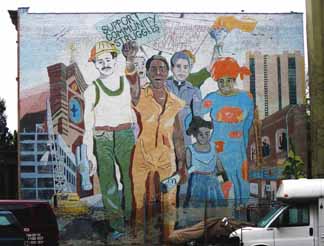 |
| A wall in Harlem. |
|---|
One of the people who was publicly humiliated at one of the Wednesday sessions was an attractive white woman who was engaged to an actor. Even after being attacked and scorned for weeks, she kept coming to work. She probably didn’t need a full-time job, but she loved being there. She loved being leered at by Harlem blacks, and was sleeping with several of her black and Hispanic coworkers. Clearly, this was kept a secret from her handsome, white, soap-opera-actor boyfriend, whom many women would have thought an enviable catch.
I should add that Streetwork was something like a cult, and tried to control every aspect of our lives. The managers set the tone and encouraged us to believe that we were immensely fortunate to have such a wonderful job in which we were loved by our clients, co-workers, and supervisors. We scorned outsiders, and believed that being “inside” was the most important thing in the world. Streetwork considered itself a self-contained, multicultural and multi-sexual paradise and model for the world. We were constantly indoctrinated and pushed to live by the narrow Streetwork dogma.
The staff were very intertwined in each other’s personal lives. We went to happy hour after work together every day, and every weekend we attended parties and various events together — always together. We gave each other advice on intimate aspects of each others’ lives, but always filtrated through the liberal, diversity, multicultural prism. For example, when I bought the house in Staten Island, I was told I should stay in a lousy apartment in a bad neighborhood, so that I could better understand the plight of the black man. I was dating a musician, who sometimes went away on tour. My “friends” told me to cheat on him as much as possible, so I wouldn’t care if he were doing it himself.
In fact, it was my boyfriend, an outsider to this world, who began to change my thinking. He is an intelligent, white, eighth grade drop-out who has traveled the world as a piano player since he was 18. He was never subjected to the multiple layers of indoctrination that the typical white, suburban person gets in high school, college, and the workforce. He even owned a copy of Jared Taylor’s Paved With Good Intentions. It took someone like him, far outside of the conventional system, to explain to me how crazy Streetwork was.
He knew that everyone at work referred to him as “that white boy you are with,” so he wrote a letter to a black staffer — one of the worst offenders — and addressed it to “Black Boy.” The purpose was not to offend, but simply to point out the hypocrisy and double standards of claiming to be “non-judgmental” while constantly slurring whites, but considering “black boy” a deep insult. My boyfriend also helped me realize that no one was ever better off at Streetwork, despite my efforts. All I saw was abuse of the system and lack of gratitude.
My attitude at work began to change. I started objecting to sexual harassment. I stopped letting Streetwork examine and analyze my personal life. This alone made me a social outcast, but the fact that I was dating a “white boy” from the suburbs was cause for great alarm. People who I thought were my friends treated me as a pariah because I was not keeping to the Streetwork policy of spurning the white man. My ideas were ignored, and incompetents were promoted to positions once promised to me. The large black man who first interviewed me called me into his office to tell me how worried and disappointed he was. He promised me a very substantial promotion if I “came back to the fold” rather than return to my “bubble.”
 |
| Staten Island: obviously dangerous for blacks. |
|---|
I handed in my resignation anyway. Vice president David Nish telephoned me and begged me to come back in for a discussion. He told me how much he cared about me and that my happiness and success were his main concern. My boyfriend agreed that I should go see him because we thought I might be offered the long-promised promotion. On the drive out to Harlem, we put together a list of offenses and abuses I had suffered. I thought that if Mr. Nish really cared about me he would correct the abuses.
When I arrived I was shocked to be greeted by an entire “intervention group.” The first thing it did was to send me back outside and tell my boyfriend, who was waiting for me, to go home. When I came back in, they all had copies of the “Black Boy” letter my boyfriend had sent. Just as he had said they would, they used the letter to label him a dangerous bigot. I was shocked to see this roomful of people, including the vice president, brandishing this personal correspondence.
Next, they lied, and claimed that my boyfriend had written letter after letter to various people within the organization. In a clear attempt to make me feel guilty, they said he was angering people throughout the organization and was getting in the way of the “the mission.”
I presented my list of abuses but they dismissed every one, saying that “this is what goes on at every job site.”
Next, David Nish explained that he had 30 years of experience observing domestic violence, and he could see blatant warning signs. He asked if my boyfriend ever hit me or got angry. I said he never hit me but was angry at how I was treated at Streetwork. “Well, that is the first step of abuse,” he said. “I’m sure that if he hasn’t started hitting you yet, he will start very soon.”
While the rest of the group looked on, gesturing their approval, he talked for an hour or more: You are in grave danger. We love you and you’ve been with us for so long. This guy you are seeing has only been around for a few months. You can’t know everything about him, but we know the warning signs. This is what we do for a living. We see the changes in you. Haven’t you noticed your coworkers have not been talking to you? That is because they miss the old Tracy, whom this new boyfriend is trying to kill. Are you going to let him kill you?
They made my boyfriend seem like he was a psychotic, dangerous bigot from whom I needed to escape. His opinions were unlike those of anyone else in my life, and he was the minority. Faced with this vast sea of important people who claimed to be on my side and against him, I felt powerless to resist, and foolish to disagree. They made me believe I was in great danger.
I look back in horror and amazement at this, but after this brainwashing I actually agreed to call my boyfriend, break up with him, and order him out of the house we were sharing. Several people listened in on the call, taking notes, and planning the next steps to make sure the breakup was permanent. Mr. Nish then sent me right back to work at my old job.
 |
While I worked, shivering from what I had been through, Mr. Nish made arrangements for me to go into a domestic violence shelter. He called my parents and friends to tell them how he had rescued me from my wicked boyfriend. He then called me back into his office and offered to call the police and send them to my home to make sure my boyfriend was out. He even ominously offered to send “some other people, not cops” to throw him out. I said that would not be necessary.
After my unexpected full day of work, I got into a taxi and was on my way to a “safe house” when the cruel absurdity of it all began to hit me. The further I rode, the clearer it became. I told the driver to change routes and take me home to Staten Island and my boyfriend. He had been bewildered by my phone call but was waiting for me, determined to speak face to face. That night, I left a message for Mr. Nish and told him I would not go back. I never did. The next morning he called me at home, but I didn’t answer the phone and he left no message.
After that, I was completely cut off from everyone associated with Streetwork. No doubt the word went out that I was to be shunned. All the people who claimed to care about me, all the people who called themselves my friend for life disappeared.
At first I couldn’t understand why the vice president of an important, non-profit organization like Safe Horizon as well as other executives would go to such bizarre lengths to keep me in their control. I would imagine it was partly because they could not stand to think that someone might not like the perfect, liberal paradise they think they have built for themselves. It deflates their sense of superiority for someone to see through them.
Later, I learned from someone who worked in personnel at Safe Horizon that Streetwork was in a crisis for several months after I left because no one knew how to do my job or even the jobs of others I had been doing for them. It seems that a madhouse of homosexuals, transgendereds, gender-non-specifics, unqualified blacks, anti-American Hispanics with poor language skills, and unrepentant gang members, all organized according to principles of diversity and multiculturalism, did not run properly without a white slave doing the work. I learned that I was doing the jobs of more than ten people who spent their days socializing, shirking work, and pilfering from the donation room.
I once believed that my experiences involving race were unique to the places where I worked. I have since heard tales similar to mine, if not so harrowing. All the whites involved meekly accepted what happened to them as part of the march of progress toward a new world and a new way.
 |
| Safe Horizon public service: white abuser and white victim. |
|---|
My father, for example, after 20 years with the New York City Transit Authority, was forced into retirement when a black man was elevated to one of the highest positions in the authority. My father once heard him say to a meeting of chiefs, “There’s too much salt in here — now I’m gonna add some pepper.” Personnel policies changed drastically in favor of blacks. It became difficult for whites to get promotions, and the workplace became intolerable for my father.
My sister works for a large medical insurance company used by most of the people who work for New York City. She is one of the secretaries to the black CEO. She is the only white person in the office, and she is kept there to do all the work the others won’t do. Her black coworkers show up two hours late, take an extra hour for lunch, and leave one or two hours early, nearly every day. Last winter, she was scolded by her boss for coming in 30 minutes late on a day when a snowstorm hit and nobody else in the office came in to work at all. Recently, a black co-worker disappeared for two weeks. When she came back, she told the boss her baby had been dying in the hospital. Later that day, it became clear that she made the story up; she just wanted a vacation. This black woman got a salary increase and was promoted over my sister’s head.
Although I have left Safe Horizon and Streetwork for good, I still see some of the things I noticed there at my current job in an emergency room, where I help doctors treat patients. The doctors spend an enormous amount of time looking after indigent, uninsured Hispanic children who have nothing more serious than skinned knees, headaches, or diarrhea. The doctors are furious at having to prescribe aspirin and Band-Aids to clueless Mexicans, and even have a saying for it: “Hispanics come dancing into the ER and whites come in on their backs.”
Everyone who works around blacks and Hispanics knows the truth about them. Many who don’t, know anyway. But the propaganda mill is always working to show things as they are not. Not long after I left my job at Streetwork, Safe Horizon produced a public service TV clip about domestic violence (you can find it on YouTube if you look for “safehorizon trailer”). The abused woman looks superficially similar to me and her abuser is a white man who looks something like my boyfriend. Perhaps it was a coincidence, perhaps not. The poor white girl goes to her non-white co-workers for help and protection.
While I was at Safe Horizon, I compiled the statistics for the shelter’s clients. Approximately 92 percent of the violence was committed by black men, 7 percent Hispanics, and less than 1 percent by white men. Somehow, Safe Horizon chose to depict an evil white man, a helpless white woman, and noble non-whites who rescue her.


