Friday, October 09, 2015
Starting a Life in Medicine Around Inclusivity
By Zoe Kornberg, writing from University of California, San Francisco
For new student orientation, I joined my first-year classmates on the Mission Bay campus for an intensive boot camp on the most widely applicable clinical procedure we will use as doctors: communication.
Dozens of faculty and staff members led the incoming class in a newly expanded diversity, bias, and inclusion training, which was developed in response to the past year’s events at UCSF and beyond. The deaths of Eric Garner and Michael Brown, among many others, at the hands of non-indicted police officers, have led to a surge of activism and awareness about racial inequality at all levels. This consciousness has led many to call for change in how black people and other disadvantaged populations are treated in health and healthcare by foregrounding issues ranging from microaggressions to community health disparities.
A Calling for Our Generation
Denise Davis, MD, the principal organizer of the two-day training, said, “Given the events in the United States in the past year, given the [White Coats for Black Lives] ‘die-in,’ given the school’s leadership retreat on race and inequality…it seemed natural to expand this part of the orientation, unlike any other medical school, to work on increasing diversity and reducing bias.”
Dean Talmadge King, Jr., MD, welcomed us into the school with a delightful speech about his life and advice for medical students. He quoted Maya Angelou’s famous line, “I’ve learned that people will forget what you said, people will forget what you did, but people will never forget how you made them feel.” I found myself thinking back to these words of wisdom during orientation, as it concisely sums up many of the communication skills we learned and practiced.
Catherine Lucey, MD, vice dean for education, gave an inspiring and memorable speech about being an intern at UCSF at the start of the HIV/AIDS epidemic in the 1980s. Lucey recounted how UCSF mounted a coordinated and multi-pronged attack against this devastating epidemic to discover the causative agent, treatment and prevention options, and a cure. While the fight against HIV and AIDS is not over, another affliction to people’s health has reached crisis levels: health inequities. Eliminating health inequities is the calling for our generation of UCSF physicians.
Language of Inclusivity
Out of the conversations that followed the deaths of Garner and Brown, UCSF medical students founded a national organization, White Coats for Black Lives (WC4BL), and organized a “die-in” at medical schools across the country to raise awareness about health inequities, especially across racial lines.
As a featured speaker, third-year medical student and WC4BL co-founder Sidra Bonner explained the importance of the subjective in the SOAP (subjective, objective, assessment, and plan) note, the basic format of a doctor’s written notes about an encounter with a patient. Typically, the subjective is the patient’s subjective account of his or her symptoms—the chief complaint. Bonner turned that idea upside down and placed the subjective role on the clinician to avoid bias and intolerance while communicating with the patient. The O, A, and P will be useless and even detrimental to the patient if the S is distorted by prejudice.
The class learned acronyms to help remember effective communication styles and watched faculty demonstrate both successful and unsuccessful interactions. We learned to use “FIFE” (function, ideas, fears, and expectations) as a guide when asking a patient open-ended questions about his or her perspective. For example, rather than asking a patient, “Do you think you have an infection?” ask “What do you think could be causing your symptoms?”
For several hours each day, over 150 students separated into groups of seven or eight to practice the communication methods and have the opportunity to give and receive constructive feedback—another critically important skill we will use in medical school. On the second day, the class watched a staged microaggression between two faculty members. The conversation was painful and awkward; we split up into our small groups to discuss what we had just witnessed. In my group, we pinpointed exactly which words and sentences used showed bias and why and discussed how a bystander to this conversation might interject appropriately.
First-year students, Hanna Burch and Alex Withers, appreciated the opportunity to break down into small groups. Burch said, “The small groups…gave us a chance to create a safe space for learning about racial bias and inclusion.” Withers expressed a similar sentiment, commenting, “I felt that all opinions were welcome in the discussion, regardless of the sensitivity of the topic, and all of us followed the mantra of ‘positive intent’ really sincerely.”
Some students have already experienced the benefits of learning about and practicing good communication habits. First-year student Jorge Mena did not expect to participate in such a comprehensive training in the first week of medical school. He said, “It has already had a tremendous impact on my daily life. I have recognized myself making quick judgments and slowed down.”
First-year student Ugomma Eze’s favorite parts of the orientation occurred when “the speakers, facilitators, and students shared their personal stories about how they grew up and what experiences shaped them. [These stories] demonstrated the importance of diversity in medicine.” First-year student Jordan Spatz felt that by hosting this orientation, UCSF showed it truly prioritizes diversity, remarking that it was “such an important topic for our medical education and sets a tone of inclusion for our medical education and beyond.”
http://medschool.ucsf.edu/features/starting-life-medicine-around-inclusivity
Monday, April 13, 2015
Another Urban Legend? The Middle Ages Were the “Dark Ages”
By David J. Theroux • Saturday April 11, 2015 9:28 PM PDT •
 As the culture wars intensify in America, let’s consider some of the roots of these contentious conflicts.
With the “Age of Enlightenment” of the 17th and 18th centuries, a “modern” narrative was invented to explain the history of the West, the wider world, and humankind’s place in the universe. This narrative claimed that liberty, democracy, republicanism and religious tolerance could only be achieved through an “Enlightenment project” of secularism taking control of both the public square and the commanding heights of society and that the abandonment of metaphysics and religious tradition were essential for human progress. Proponents of this narrative then included Denis Diderot, Voltaire, Jean-Jacques Rousseau, Edward Gibbon, and David Hume, and in the 19th century such writers as John Draper and Andrew Dickson White. With some exceptions, this worldview came to dominate western elite and popular thinking. However many historians have since increasingly challenged this narrative as fundamentally fallacious. Such historians as J.G.A. Pocock, Dale Van Kley, Derek Beales, and Jonathan Israel have discarded the claim of an exclusively secular “Enlightenment” and shown that there have been multiple and far more causal Enlightenments, based in various Catholic, Protestant and Jewish traditions. In addition and since the 1970s, historians of science Ronald L. Numbers, David V. Lindberg, and James R. Moore have refuted the erroneous and indeed propagandistic, secular claims of Draper and White that Christianity and science are adversarial.
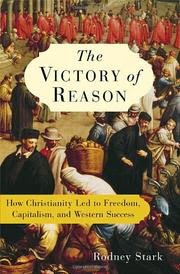
Indeed, it has been these religious traditions that were primarily responsible for the revolutionary economic, legal, technological, and cultural changes that have uplifted the West, and that such changes began well before the 17th century. Sociologist Rodney Stark has shown that it was the Judeo-Christian tradition that produced all aspects of progress in the West, including the ideas of objective morality and truth, free-market capitalism, reason and science, natural law, individual liberty and the abolition of slavery and infanticide, civic virtue, and the rule of law. (Among his many notable books are The Victory of Reason, The Triumph of Christianity, How the West Won, and For the Glory of God.)
In “The Secular Theocracy,” I have also discussed the “Enlightenment project”‘s hypocritical and intolerant crusade that “exalts a sovereign and powerful state that pervades all of life and compels obedience not just to its mandates but to the secular nationalism of the Zeitgeist itself, for which the populace is forced to conform to and fund.”
Stark and others have further shown that the “secular Enlightenment” narrative rests upon numerous historical falsehoods that today are still taken for granted and commonly taught in schools. The following video discusses one such fallacy—why the Middle Ages were not the “Dark Ages,” including the “urban legend” that people then believed in a Flat Earth:
http://blog.independent.org/2015/04/11/another-urban-legend-were-the-middle-ages-really-the-dark-ages/
Sunday, April 12, 2015
Forgotten Civil War atrocities bred more carnage
George Orwell wrote in 1945 that “the nationalist not only does not disapprove of atrocities committed by his own side, but he has a remarkable capacity for not even hearing about them.” The same moral myopia has carried over to most Americans’ understanding of the Civil War. While popular historians have recently canonized the war as a practically holy crusade to free the slaves, in reality civilians were intentionally targeted and brutalized in the final year of the war.
The most dramatic forgotten atrocity in the Civil War occurred 150 years ago when Union Gen. Philip Sheridan unleashed a hundred-mile swath of flames in the Shenandoah Valley that left vast numbers of women and children tottering towards starvation. Unfortunately, the burning of the Shenandoah Valley has been largely forgotten, foreshadowing how subsequent brutal military operations would also vanish into the Memory Hole.
In August 1864, supreme Union commander Ulysses S. Grant ordered Sheridan to “do all the damage to railroads and crops you can…. If the war is to last another year, we want the Shenandoah Valley to remain a barren waste.” Grant said that Sheridan’s troops should “eat out Virginia clear and clean as far as they go, so that crows flying over it for the balance of the season will have to carry their provender with them.” Sheridan set to the task with vehemence, declaring that “the people must be left nothing but their eyes to weep with over the war” and promised that when he was finished, the valley “from Winchester to Staunton will have but little in it for man or beast.”
Because people lived in a state that had seceded from the Union, Sheridan acted as if they had automatically forfeited their property, if not their lives. Along an almost 100-mile stretch the sky was blackened with smoke as his troops burned crops, barns, mills and homes.
War against civilians
Some Union soldiers were aghast at their marching orders. A Pennsylvania cavalryman lamented at the end of the fiery spree, “We burnt some sixty houses and all most of the barns, hay, grain and corn in the shocks for fifty miles [south of] Strasburg…. It was a hard-looking sight to see the women and children turned out of doors at this season of the year.” An Ohio major wrote in his diary that the burning “does not seem real soldierly work. We ought to enlist a force of scoundrels for such work.” A newspaper correspondent embedded with Sheridan’s army reported, “Hundreds of nearly starving people are going North … not half the inhabitants of the valley can subsist on it in its present condition.”
After one of Sheridan’s favorite aides was shot by Confederate soldiers, Sheridan ordered his troops to burn all houses within a five-mile radius. After many outlying houses had been torched, the small town at the center — Dayton — was spared after a federal officer disobeyed Sheridan’s order. The homes and barns of Mennonites — a peaceful sect that opposed slavery and secession — were especially hard hit by that crackdown, according to a 1909 history of Mennonites in America.
By the end of Sheridan’s campaign the former “breadbasket of the Confederacy” could no longer even feed the women and children remaining there. In his three-volume Civil War history, Shelby Foote noted that an English traveler in 1865 “found the Valley standing empty as a moor.” The population of Warren County, Virginia, where I grew up, fell by 11 percent during the 1860s thanks in part to Sheridan’s depredations.
Historian Walter Fleming, in his classic 1919 study, The Sequel to Appomattox, quoted one bedeviled local farmer: “From Harper’s Ferry to New Market, which is about eighty miles, the country was almost a desert…. The barns were all burned; chimneys standing without houses, and houses standing without roof, or door, or window.” John Heatwole, author of The Burning: Sheridan’s Devastation of the Shenandoah Valley (1998), concluded, “The civilian population of the Valley was affected to a greater extent than was the populace of any other region during the war, including those in the path of Sherman’s infamous march to the sea in Georgia.”
Unfortunately, given the chaos of the era at the end of the Civil War and its immediate aftermath, there are no reliable statistics on the number of women, children, and other civilians who perished thanks to “the burning.”
Abraham Lincoln congratulated Sheridan in a letter on Oct. 22, 1864: “With great pleasure I tender to you and your brave army the thanks of the nation and my own personal admiration and gratitude for the month’s operation in the Shenandoah Valley.” The year before, in his Gettysburg Address, Lincoln had justified the Civil War to preserve a “government by consent.” But, as Massachusetts abolitionist Lysander Spooner retorted, “The only idea … ever manifested as to what is a government of consent, is this — that it is one to which everybody must consent, or be shot.”
Some defenders of the Union military tactics insist that there was no intent to harshly punish civilians. But, after three years of a bloody stalemate, the Lincoln administration had adapted a total-war mindset to scourge the South into submission. As Sheridan was finishing his fiery campaign, Gen. William Sherman wrote to Grant that “until we can repopulate Georgia, it is useless to occupy it, but the utter destruction of its roads, houses, and people will cripple their military resources.” Sherman had previously telegrammed Washington that “there is a class of people — men, women, and children — who must be killed or banished before you can hope for peace and order.” Lincoln also congratulated Sherman for a campaign that sowed devastation far and wide.
The carnage inflicted by Sheridan, Sherman, and other northern commanders made the South’s postwar recovery far slower and multiplied the misery of both white and black survivors. Connecticut College professor Jim Downs’s recent book, Sick from Freedom, exposes how the chaotic situation during and after the war contributed to the deaths of hundreds of thousands of freed slaves.
Afterward
Ironically, a war that stemmed in large part from the blunders and follies of politicians on both sides of the Potomac resulted in a vast expansion of the political class’s presumption of power. An 1875 American Law Review article noted, “The late war left the average American politician with a powerful desire to acquire property from other people without paying for it.”
The sea change was clear even before the war ended. Sherman had telegraphed the War Department in 1863, “The United States has the right, and … the … power, to penetrate to every part of the national domain. We will remove and destroy every obstacle — if need be, take every life, every acre of land, every particle of property, everything that to us seems proper.” Lincoln liked Sherman’s letter so much that he declared that it should be published.
After the Civil War, politicians and many historians consecrated the conflict and its grisly tactics were consigned to oblivion. The habit of sweeping abusive policies under the rug also permeated post–Civil War policy towards the Indians (Sheridan famously declared that “the only good Indian is a dead Indian”) and the suppression of Filipino insurgents after the Spanish-American War. Later historians sometimes downplayed U.S. military tactics in World War II that killed vast numbers of German and Japanese civilians.
The same pattern is repeating with the Vietnam War. The Pentagon is launching a major effort to commemorate its 50th anniversary — an effort that is being widely denounced as a whitewash. The New York Times noted that the Pentagon’s official website on the war “referred to the 1968 My Lai massacre, in which American troops killed hundreds of Vietnamese civilians, as the My Lai Incident.” That particular line was amended but the website will definitely not be including the verdict of David Hackworth, a retired colonel and the most decorated officer in the Army: “Vietnam was an atrocity from the get-go…. There were hundreds of My Lais. You got your card punched by the numbers of bodies you counted.”
The failure to recognize how wars routinely spawn pervasive brutality and collateral deaths lowers Americans’ resistance to new conflicts that promise to make the world safe for democracy, or rid the world of evil, or achieve other lofty-sounding goals. For instance, the Obama administration sold its bombing of Libya as a self-evident triumph of good over a vile despot; instead, chaos reigns. As the administration ramps up bombing in Syria and Iraq, both its rhetoric and its tactics echo prior U.S. misfires. The proclaimed intentions of U.S. bombing campaigns are far more important than their accuracy. And the presumption of collective guilt of everyone in a geographical area exonerates current military leaders the same way it exonerated Sheridan’s 1864 torching of Mennonite homes.
Since 1864, no prudent American should have expected this nation’s wars to have happy or uplifting endings. Unfortunately, as long as the spotlight is kept off atrocities, most citizens will continue to underestimate the odds that wars will spawn debacles and injustices that return to haunt us.
SOURCE
Friday, February 20, 2015
Father Charles E. Coughlin
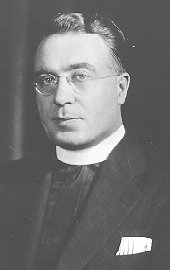
Father Coughlin first took to the airwaves in 1926, broadcasting weekly sermons over the radio. By the early 1930s the content of his broadcasts had shifted from theology to economics and politics. Just as the rest of the nation was obsessed by matters economic and political in the aftermath of the Depression, so too was Father Coughlin. Coughlin had a well-developed theory of what he termed "social justice," predicated on monetary "reforms." He began as an early Roosevelt supporter, coining a famous expression, that the nation's choice was between "Roosevelt or ruin." Later in the 1930s he turned against FDR and became one of the president's harshest critics. His program of "social justice" was a very radical challenge to capitalism and to many of the political institutions of his day.
Father Coughlin was an early and passionate supporter of President Roosevelt, since he viewed FDR as a radical social reformer like himself. Roosevelt's rhetoric during his inaugural address implicitly promised to "drive the money changers from the temple." This was music to Coughlin's ears since a core part of his own message was monetary reform. Roosevelt's early monetary policy seemed to fulfill this promise and so Coughlin viewed him as the savior of the nation. But when FDR failed to follow-on with additional radical reforms, Coughlin turned against him. By 1936, he would support a third-party candidacy against FDR's reelection bid and would even say this of Roosevelt:
"The great betrayer and liar, Franklin D. Roosevelt, who promised to drive the money changers from the temple, had succeeded [only] in driving the farmers from their homesteads and the citizens from their homes in the cities. . . I ask you to purge the man who claims to be a Democrat, from the Democratic Party, and I mean Franklin Double-Crossing Roosevelt."
Father Coughlin's influence on Depression-era America was enormous. Millions of Americans listened to his weekly radio broadcast. At the height of his popularity, one-third of the nation was tuned into his weekly broadcasts. In the early 1930s, Coughlin was, arguably, one of the most influential men in America. Although his core message was one of economic populism, his sermons also included attacks on prominent Jewish figures--attacks that many people considered evidence of anti-Semitism. His broadcasts became increasingly controversial for this reason, and in 1940 his superiors in the Catholic Church forced him to stop his broadcasts and return to his work as a parish priest.
http://www.ssa.gov/history/cough.html
Monday, August 04, 2014
Maine political activist Andrew Ian Dodge dies at age 46
A Colby College graduate, Dodge announced in June that he had incurable cancer.
Andrew Ian Dodge knew months ago that his life would soon be coming to end, so he composed a final statement, which was posted by his wife to his website Sunday morning.
The former Libertarian candidate for the U.S. Senate and Maine tea party activist wrote about his love for music, politics and writing – and his deep affection of his wife, Kim – in his farewell message.
Dodge, 46, died Friday morning at his home in Harpswell, where he was being cared for by his wife, whom he married in 2007, and his mother, Elizabeth.
His mother said Dodge died of an incurable form of colon cancer.
“If you are reading this I will have succumbed to the forces of cancers that have been ravaging my body for the last little while. The last fight betwixt my body with the help of cancer treatment and cancer has not gone according to plan. The hordes of cancer plague entities have felled their host on the battlefield of life,” Dodge wrote.
Dodge graduated from Colby College in Waterville and obtained a postgraduate degree in British politics from Hull University in the United Kingdom. He said he met Kim at a London club in 2005.
“She has stuck by with love, affection and care all the way through,” Dodge wrote in his final statement.
“Ultimately, everything in my life for good or ill led me to meet this wonderful woman, therefore I can have no regrets. She is of great talent, compassion, love and fortitude.”
Dodge, a tea party activist and freelance writer, became a candidate for the Senate in 2012 after Sen. Olympia Snowe announced she would not seek re-election.
Independent Angus King defeated Dodge, Democrat Cynthia Dill and Republican Charlie Summers in the November election that year.
Dodge was the lowest vote getter in the Senate election, receiving 5,624 votes, or 0.8 percent of the votes. King received 370,580 votes, or 51.1 percent.
“I’m very sorry to hear he died,” said Jack Wibby, chairman of the Cumberland County Tea Party Patriots. Wibby said he did not know Dodge very well, adding, “He was way too young to lose his life.”
Elizabeth Dodge described her son Sunday night as a well-rounded individual who enjoyed music, especially heavy metal music, writing novels and stories, and composing political columns for his local newspaper, the Brunswick Times Record.
“It was a wonderful (political) column because he wrote what he thought. His political opinion never changed, even as he aged,” Elizabeth Dodge said. “He didn’t write to please anyone.”
“He was also a prolific reviewer of music,” his mother said. He started writing music reviews for Blogcritics.com about 20 years ago under the alias Marty Dodge.
Dodge’s mother said she has been struck by the outpouring of sympathy after friends and others learned that her son had passed away.
Raheem Kassam, a writer for Breitbart.com, a conservative news and opinion website in London, wrote a column Sunday about the death of Dodge, whom he describes as his friend.
“He was an incredible character and someone I feel lucky to have been able to call a co-conspirator and brother. We worked together on a number of projects, and he was supportive of a number of different websites I founded and edited,” Kassam wrote.
Kassam mentioned Harpswell as his friend’s hometown, adding, “Residents of the 5,000-strong town will no doubt have known and loved him dearly.”
“There was no way one could resist his charm, and he often drew me into political discussions in the middle of my work day over Facebook. I could rarely resist having a gossip with him,” Kassam said.
Kassam said Dodge wrote for the Huffington Post, Trending Central, the Canada Free Press, and the Washington Examiner. He said his friend was also a huge fan of “Baroness Thatcher” and President Ronald Reagan.
Dodge had known his health was getting worse and in June posted a tweet on his website that said, “If you are wondering why I have been a bit flaky and inconsistent in the last few months … There is a reason: I have incurable cancer. We are trying to figure out the best course of action regarding chemo and treatment. Kim Benson, my beloved wife, has been a rock throughout. We shall fight this with all our might.”
http://www.pressherald.com/2014/08/04/maine-political-activist-andrew-ian-dodge-dies-at-age-46/
Thursday, September 26, 2013
Perspectives on the George Zimmerman/Trayvon Martin shooting
By Massad Ayoob
The media told us a self-appointed neighborhood watch captain and wannabe cop with gun-derived courage was on patrol when he profiled a young child because he was black and wearing a hoodie, and that he stalked and gunned down the helpless youth out of sheer malicious bloodlust. The media trumpeted that theme so loudly that most of America believed it. When the killer was acquitted, there was national and even international outrage. It was a bandwagon made for anti-gunners to leap on, from the Brady Organization to the White House, and they jumped on it with more feet than a nest of spiders.
The trouble was, it wasn't like that at all. George Zimmerman had been named head of the watch group by his own neighbors. While he had considered a career in criminal justice and taken some classwork in that area, he had also been offered a quasi-police patrol car and uniform by the police department that coordinated with the Neighborhood Watch, and had turned it down. Zimmerman wasn't "on patrol" in his private vehicle on that proverbial dark and rainy night; the evidence showed he was simply driving to a Target store to buy some lunch makings for work that week.
En route, he observed a tall young man in a dark hoodie, the favored garb of the local "gangsta" set ... not hurrying home in the driving rain, but looking in windows and doing a convincing imitation of a burglar "casing" his next target. Eye contact was made, and Zimmerman reported to the dispatcher that the "suspect" was running away. The dispatcher asked in what direction the man was running, and where the responding officer should meet Zimmerman, the complainant. In a large development of look-alike homes, Zimmerman wasn't sure what street he was on and couldn't see a street sign. Also indoctrinated by Neighborhood Watch training to be "the eyes and ears" of the authorities — and literally talking to "the voice of authority," the police dispatcher — he stepped out of his car to reconnoiter so he could answer both questions. As he moved in the direction where the man in the hoodie had disappeared, the dispatcher asked if he was following that person. Zimmerman replied in the affirmative. The dispatcher told him he didn't have to do that, and the evidence shows that Zimmerman then stopped following and headed back toward his vehicle.
Meanwhile, Trayvon Martin was talking to a female friend on his Android, telling her a "creepy ass cracka'" was following him, but Trayvon had lost the "nigga," and he was close to the unit where he was staying. Minutes passed ... and, the timeline showed, during those minutes Trayvon Martin had to have moved away from his nearby safe haven and toward Zimmerman's position. If he was afraid, why didn't Martin call police with the phone already in his hand ... or simply, "go home?"
Zimmerman said he was confronted and then attacked, his testimony consistent with the last words Martin's female friend heard before his phone went dead. Neighbors heard — and one neighbor clearly saw — the struggle. Someone was screaming piteously for help. There was a single shot. The screaming stopped.
Police arrived a minute later.
Trayvon Martin, 17, was dead, killed by a single 115 grain 9mm Sellier & Bellot hollow point bullet fired from the Kel-Tec PF9 pistol of George Zimmerman. Zimmerman was well-bloodied, his nose smeared across his face, the back of his head lacerated from where he said Martin had been smashing his skull against the sidewalk after knocking him down with a powerful punch to the face, followed by a rain of blows and a mixed martial arts "mount." Testimony of the key eyewitness was consistent with Martin atop Zimmerman. The only injuries on Martin were the single gunshot wound and knuckle scraping consistent with him giving, not taking, a beating.
All this, the jury knew. The cops who chose not to arrest him, knew more, and the lawyers who brilliantly defended Zimmerman knew even better by time of trial. He was no racist; an FBI investigation prior to his trial showed Zimmerman had mentored black kids, and had black friends. He was part black himself on his mother's side. A lie-detector test (voice stress analysis) shortly after the shooting showed Zimmerman to be telling the truth.
At time of death, Martin, a regular pot smoker and apparently a drug dealer as well, was enamored of a narcotic concoction called "lean" or "purple drank," made by mixing cough syrup with candy like Skittles and fruit cocktails like the Arizona Watermelon drink that the media turned into "iced tea" because they couldn't bear to connect watermelons and black people. Martin had a history of street-fighting and of being dissatisfied that one victim didn't bleed enough, and had been negotiating to illegally buy a handgun. There had also been suspicion of burglary prior. This sort of thing was what got him kicked out of school in the Miami area, and which convinced his good Mom to send him to his Dad out of tough love, which is why Trayvon Martin was in Sanford in the first place. None of this information, gleaned from Martin's cell phone and other sources, ever made it to the jury: the judge ruled that since Zimmerman didn't know it, it was not germane to his decision to shoot, for which he was being judged.
But what the jury did know was enough. Following isn't stalking. Being followed isn't justification for trying to literally beat a man's brains out. Having your skull smashed into hard surfaces is likely to kill you, and the universal laws of man and God allow you to kill your attacker to make him stop doing that to you. The forensic evidence and the bulk of the testimony alike were consistent with Zimmerman's account of self-defense. The state's witnesses, one after the other, turned into defense witnesses. In the end, the state's theory amounted to ... nothing.
That prosecution theory, in turn, evolved from the media ... and, tracked back further, the media's fantasy of what happened evolved from a brilliant left-wing public relations firm hired by the lawyer who was hired by the family of the deceased. For more information on this, see my July 2013 entries in the blog at www.backwoodshome/blogs/massadayoob.
The PR folks outraged the media, and the media inflamed the public. Enraged people, once invested in their emotion, have trouble facing contradictory facts and evidence. Fortunately, the Zimmerman jury recognized the facts, and the evidence. They — like the original investigating officers who believed Zimmerman, like the original prosecutor who saw no reason to prosecute, like the FBI agents who investigated Zimmerman and found no hint of racism, and like the member of the Special Prosecutor's office who was fired for doing what prosecutors are supposed to do and turning over exculpatory evidence to the defense — did Justice.
"What do we tell our kids after this?" How about we tell them not to do drugs and not to violently, illegally assault people? Tell them to call 9-1-1 as soon as they perceive a threat? And perhaps we should warn them too that if they defend themselves from life-threatening assault, they should be prepared to face the misdirected, powerful wrath of the clueless and politically driven ... a powerful force being directed against George Zimmerman from multiple angles even now, at this writing.
http://www.backwoodshome.com/articles2/ayoob143.html
Sunday, July 14, 2013
Some Trayvon Martin background

As thousands of people gathered here to demand an arrest in the Trayvon Martin case, a more complicated portrait began to emerge of a teenager whose problems at school ranged from getting spotted defacing lockers to getting caught with a marijuana baggie and women’s jewelry.
The Miami Gardens teen who has become a national symbol of racial injustice was suspended three times, and had a spotty school record that his family’s attorneys say is irrelevant to the facts that led up to his being gunned down on Feb. 26.
In October, a school police investigator said he saw Trayvon on the school surveillance camera in an unauthorized area “hiding and being suspicious.” Then he said he saw Trayvon mark up a door with “W.T.F” — an acronym for “what the f---.” The officer said he found Trayvon the next day and went through his book bag in search of the graffiti marker.
Instead the officer reported he found women’s jewelry and a screwdriver that he described as a “burglary tool,” according to a Miami-Dade Schools Police report obtained by The Miami Herald. Word of the incident came as the family’s lawyer acknowledged that the boy was suspended in February for getting caught with an empty bag with traces of marijuana, which he called “irrelevant” and an attempt to demonize a victim.
Trayvon’s backpack contained 12 pieces of jewelry, in addition to a watch and a large flathead screwdriver, according to the report, which described silver wedding bands and earrings with diamonds.
Trayvon was asked if the jewelry belonged to his family or a girlfriend. “Martin replied it’s not mine. A friend gave it to me,” he responded, according to the report. Trayvon declined to name the friend.
Trayvon was not disciplined because of the discovery, but was instead suspended for graffiti, according to the report. School police impounded the jewelry and sent photos of the items to detectives at Miami-Dade police for further investigation.
More HERE
Saturday, April 13, 2013
Margaret Thatcher's proudest moment was saving an Austrian Jew
When Margaret Thatcher passed away today, the tributes began pouring in from all over the world. Mrs. Thatcher was Britain’s first female prime minister, serving for 11 years starting in 1979. Known as the Iron Lady, she was a strong Conservative who changed England’s perspective on its economic and political life.
Despite her many impressive accomplishments, including fighting the Soviet communist regime, Thatcher said that her proudest moment was when she saved a Jewish teenager from Austria during the Holocaust.
In 1938, Edith Muhlbauer, a 17-year-old Jewish girl, sent a letter to Muriel Roberts, Edith’s pen pal and the older sister of Margaret Thatcher, asking if the Roberts family could help her escape from Austria. The Nazis had started rounding up Jews from Vienna and Edith knew it was just a matter of time before she would be among them.
Alfred Roberts, the father of Muriel and Margaret, was a grocer in a small town. They lived in a cold water flat above the grocery with an outhouse; the Roberts did not have the time or the money to bring Edith to their home. So Margaret, then 12 and Muriel, 17, decided to try raising money and asking the local Rotary club to help. They succeeded in bringing Edith to England where she stayed with several Rotary families, including the Roberts for the next two years before joining relatives in South America.
Edith slept in Margaret’s room and Thatcher later wrote in her memoir: “She was tall, beautiful, evidently from a well to do family. But most important, she told us what it was like to live as a Jew under an anti-Semitic regime. One thing Edith reported particularly stuck in my mind. The Jews, she said, were being made to scrub the streets.”
In 1995, after Edith had been located in Brazil, she told audiences, “Never hesitate to do whatever you can for you may save a life.”
Edith is now a Jewish grandmother in Sao Paolo who says that she owes her life and the life of her children and grandchildren to Margaret Thatcher’s family. When Thatcher visited Yad Vashem during a historic, first visit to Israel by a British prime minister in 1986, she was visibly shaken as she stood in front of a photo of a German soldier shooting a Jewish mother and child.
She exclaimed, “It is so terrible. Everyone should come and see it so that they never forget. I am not quite sure whether the new generation really knows what we are fighting against.”
Thatcher continued to be a loyal friend to the Jews as she fought the British support for the Arab boycott of Israel, protested on behalf of Jewish refuseniks in the Soviet Union and chose several Jewish leaders to be part of her cabinet. Thatcher admired the hard work and self-reliance of the British Jewish community and frequently turned to England’s late chief rabbi, Immanuel Jakobovits for spiritual back up. She even elevated Rabbi Jakobovits to the House of the Lords and he later became known as “Thatcher’s rabbi.”
Thatcher also made the following statement about Israel’s security: “Israel must never be expected to jeopardize her security; if she was ever foolish enough to do so and then suffered for it, the backlash against both honest brokers and Palestinians would be immense - ‘land for peace’ must also bring peace.”
Thatcher spoke up with such courage and strength because as she described herself, “This lady is not for turning.” When she believed in an ideal, whether it was transforming the British economy or saving a terrified Jew from Austria, she was not afraid to follow through, even if she had to stand up against popular opinions to do so.
There were so many reasons why twelve year old Margaret and her sister could have thrown up their hands in despair and stuffed Edith’s letter into a drawer in their tiny, freezing apartment. They had no money, no power and no idea how they would be able to rescue this terrified girl that they had never met. But they believed that they could and should do everything that they can to help. They knew even then that there was room in the world for great leaders, even if they were only twelve years old and living above a small town grocery store with no hot water.
We pay tribute to Margaret Thatcher for her friendship and work with the Jewish people. For her wise words and inspiring courage. And for teaching us, that above all else, the greatest achievement in life is sometimes not one that earns you a trophy or money or even a powerful position. Sometimes it’s the quiet, determined accomplishments that no one hears about until years later.
http://www.aish.com/ci/s/A-Tribute-to-Margaret-Thatcher.html


